
During August, SCA carried out field excursions Älvsbyn and Strömsund with Sami villages that we coordinate our co-planning with. Interest in the meetings was high, and more than 30 reindeer herders from 15 Sami villages took part.
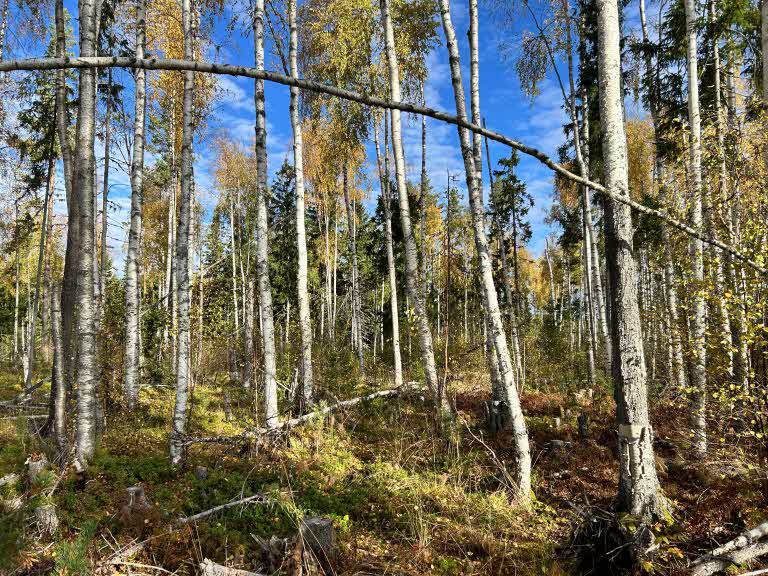
Continuous-cover forestry excursion in SCA’s forests
- News
- Forest
In brief
- SCA hosted a field excursion for the Collaborative Group for Continuous Cover Forestry in southern Norrland.
- The group visited four forests in Ångermanland where SCA has used continuous cover methods and discussed how the methods affect the forest’s different values.
- The conclusion was that practical studies and dialogue in the forest are important for developing continuous cover forestry.
In September, SCA hosted a field excursion for the Collaborative Group for Continuous-Cover Forestry in Southern Norrland. The group visited four sites where SCA has applied different continuous-cover methods. “It is important that we meet and discuss these issues so that, together, we can identify which methods may work”, says Anna Cabrajic, Forest Ecologist at SCA.
The Collaborative Group for Continuous-Cover Forestry in Southern Norrland was formed in autumn 2023. The aim is to promote learning and exchange experience around continuous-cover forestry and other management approaches that increase forest diversity and support the production of high-quality timber for building conservation.
The field excursion attracted nearly 20 participants, who gathered at Ejdån near Graninge in Ångermanland. Representatives from the Swedish Forest Agency, Sveaskog, the County Administrative Board of Västernorrland, the Swedish Environmental Protection Agency and the Swedish Society for Nature Conservation were among those present. Several other forestry companies that are also part of the collaborative group had been invited but were unable to attend.
“We had selected examples of different shelterwood stands as well as selection system harvestingand single-tree selection, to discuss how these methods and measures can be used to consider, preserve and restore different values”, says Askia Sandberg, SCA’s Conservation Specialist in Ångermanland.

Creating a deciduous tree stand
The first stop was a deciduous shelterwood stand where SCA harvested mainly spruce in 2018 to create a birch-dominated habitat that will in time be used for timber production.
“The site itself does not have particularly high nature values, but SCA is working to increase the proportion of deciduous forests as part of FSC certification, and this was a good location for that. Here, the birches can continue to age, and in time we can thin the shelterwood stand”, says Askia. Many birds benefit from deciduous-rich forests with old birch trees, so the measure also supports birdlife in the area.
The group discussed the advantages and disadvantages of the measure and considered what the next step might be in about ten years. It was also noted that establishing new forest may be challenging without any form of site preparation or planting. Continuous-cover forestry is usually based on natural regeneration, but site preparation and planting can also be carried out in gaps and beneath shelterwoods.
“The area is fairly wet, so favouring thirsty birches is an advantage”, was one comment.
If the birches had not been retained, the ground would have become much wetter. Without birches that use a lot of water, it would have been difficult to establish regeneration.
Postponed shelterwoods

The group then travelled to Viksmon, where SCA has used the postponed pine shelterwood method in three areas. There are pines that are 160 years old, as well as sandy pine forest.
“These forests have been heavily used for a long time because there used to be an ironworks here”, says Askia, continuing:
“Here we have several examples of pine shelterwoods. Some have been left unmanaged and preserved for social reasons because they are an important recreation area for local residents. In the long term, we may be able to carry out some selection cutting, but then we must be careful to preserve the trails”.

In the second area, SCA harvested some timber in two rounds, in 1995 and 2008, and the stand now consists of 138 stems per hectare. The shelterwood of older pine is fairly dense, with a relatively tall and dense young stand of pine and broadleaf trees underneath, the group observed. However, there were clear bare patches around some retained pines, where the older trees outcompete the regenerating seedlings so they do not receive enough nutrients or light.
“Pines require a lot of light, and that can make regeneration difficult in the long term. The older pine shelterwood may need to be thinned further for the young stand to establish itself”, the group reflected.
The developing young forest will also need to be thinned through cleaning and later thinning, several participants noted.
“But if you thin too much, it will not become a multi-layered forest”, the Swedish Society for Nature Conservation pointed out.
“A more open forest is beneficial for reindeer husbandry. Open stands support ground lichens”, said several forestry specialists with a focus on reindeer management.
Balancing different values
This led the group into a discussion about the challenge of balancing the forest’s different values and how environmental values can best be weighed against social and economic values. The conclusion was that measures that are positive for some values may be perceived as negative for others.
“But we are in a forest, Anna asked. What does it feel like to you?”
Everyone agreed that the forest feeling was certainly there.
Lars-Olov Sarenmark from the Swedish Environmental Protection Agency stressed the importance of adapting the management method to the site conditions. This means that some methods are better suited to certain conditions. For example, retaining a shelterwood in a wetter forest is sensible in order to preserve a “water pump” that helps keep water in check so that new seedlings can establish. Another example is that soil scarification and planting are not needed in areas that regenerate easily, in some sandy pine forests. But this requires very strong local forest knowledge, and today few people have that knowledge.
In the third area, which the group did not have time to visit, timber was harvested in 2008 and the shelterwood was then thinned a few years ago to 25 stems per hectare, fully in line with the Swedish Forest Agency’s guidelines for postponed shelterwood in continuous-cover forestry.
Selection system in spruce forest
After lunch, the group visited an area of sparse, low-volume spruce forest with some older trees, where SCA had carried out selection system harvesting.

“The selection system harvesting was carried out in 2024. The stand itself does not have high nature values, but it lies within a consideration area that contains a number of protected species. That is why we chose a continuous-cover method, where our first action was to harvest only in extraction trails, with a timber removal of around 20 per cent. In 15–20 years, we can reuse the trails and remove a certain proportion of larger trees beside them”, explained Askia.
The Swedish Society for Nature Conservation questioned why the forest needed to be harvested at all.
“According to SCA’s criteria, this is not forest with such high values that it justifies voluntary set-aside. But by using an alternative method, we can preserve the habitat for species while carrying out a cautious timber harvest. In this way, we avoid creating a clearcut, yet still achieve a certain timber yield. At the same time, birds and plants that depend on forest, such as the Siberian jay or creeping lady’s-tresses, can remain”, explained Askia.
“Selection system is a gentle method, said one participant. This becomes a win-win situation, where we can both preserve and use the forest.”
“Alternative forestry is important, and we need to test and see what works”, another participant commented.
“SCA has followed up the implementation, but this year is the first time Skogforsk is systematically monitoring continuous-cover methods so that the sector can see how they work and learn more”, Anna said.
The group also discussed the costs of continuous-cover measures, and SCA’s compilations show that harvesting costs can be fairly high for some methods. Selection cutting, for example, is almost twice as expensive as establishing a shelterwood.
“But cost is not the main focus when we choose alternative methods; instead, we look at what works best in the stand”, said Anna.
Single-tree selection in broadleaf forest
The final stop of the day was in a broadleaf-rich forest where SCA carried out single-tree selection fellings a few years ago. The stand contains many aspens, older broadleaf trees, and some spruce and pine.

“We want to create a more open stand with a high proportion of broadleaf trees. We mainly harvested spruce but also thinned other trees to create a park-like character,” explained Askia.
The group felt, however, that the forest was still somewhat too dense, although there was a fine variation of tree species of different ages in the stand. Now it is a matter of waiting to see how the forest develops over time.
Rewarding to meet
When the day was finally summed up, everyone agreed that it is very rewarding to meet and talk, and that it has great value to get out and see practical examples in the forest.
“We will continue to keep our meetings together and make sure to go out into the forest to learn more”, concluded Ulf Flygar, advisory specialist at the Swedish Forest Agency and convener of the collaborative group.
Photo: Misan Lindqvist
Latest news on this topic

SCA land host for major road project
The EU project Northern Traffic Lights aims to develop digital solutions that can monitor and predict the trafficability and maintenance needs of private gravel roads. SCA is participating as a land host in a project part led by Skogforsk, anh has now two advanced weather stations on its road network along tin northern Sweden.

SCA has re-wetted 150 hectares of wetland in Västerbotten
Over the past year, SCA has blocked ditches across a 150-hectare wetland area in Lycksele Municipality. In total, around 15 km of century-old ditches have been restored with funding through LONA. “We can already see positive effects of the re-wetting",says Ulf Hallin, Nature Conservation Specialist at SCA.