
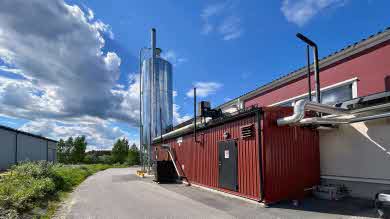
Sawdust, a residual product from SCA’s sawmill, powers BEWI’s steam boiler. A fossil-free and efficient solution that provides both process heat and heating for the facilities. Read more about how BEWI harnesses energy, recycles waste, and produces insulation material made of 98% air.

From by-product to efficient biofuel
Pellet production involves much more than simply compressing sawdust. Through drying, refining, and pelletising, raw sawdust is transformed from a moist and bulky by-product into a dry, energy-dense biofuel that is easy to store, transport, and use.
How pellets are produced at our largest facility, Bionorr in Härnösand
Sawdust is transported from local sawmills to the production site, where it is handled by wheel loaders and fed into the manufacturing process. Spruce and pine sawdust are blended, then ground into a fine powder in a mill while hot flue gases are introduced to dry the material.
The dried and finely ground powder is then compressed through die holes, forming the pellets.
When the pellets leave the die, their temperature is approximately 100°C. They are then cooled to a suitable storage temperature. After storage, the pellets are screened and subsequently delivered to customers either in bulk or in bags.
No additives are used in the production process. The pellets consist solely of spruce and pine sawdust.


Renewable energy in production

In 2024/2025, 96.8% of the energy used to produce pellets in Härnösand was renewable. The electricity was sourced from wind power and bioenergy. Sawdust screened out during pellet production was reused as drying energy.
The remaining 3.2% came primarily from transporting sawdust to the production facility and from vehicle operations within the plant area.
The calculation includes sawdust transport from sawmill to factory, internal transport within the production site, electricity consumption, and drying energy.
Additive-free pellets
No additives are used when the sawdust is dried, milled, and compressed into pellets. Wood naturally contains a substance called lignin, which acts as a binding agent. Lignin holds wood fibres together and enables trees to stand upright. When exposed to heat and high pressure during pellet production, lignin binds the sawdust particles together, forming durable pellets without the need for added binders.
Surplus heat from pellet production helps heat Härnösand
Surplus heat generated during pellet production is supplied to the local combined heat and power (CHP) plant operated by Härnösand Energi & Miljö. In 2025, surplus heat from Bionorr contributed 17% of the CHP plant's total energy input.
Source: Härnösand Energi & Miljö.
The answer is that pellets have several properties that make them a far more practical and transport-efficient fuel than raw sawdust.
- Lower Moisture Content and Higher Energy Value
Fresh sawdust from sawmills often has a moisture content of around 50%. This means that a large portion of its weight consists of water, which significantly reduces its energy value as a fuel.
During pellet production, the sawdust is dried and compressed under high pressure. Finished wood pellets typically have a moisture content of around 6-10% (7% for SCA pellets) and therefore contain considerably more energy per tonne.
- 1 m³ of SCA Pellets Contains as Much Energy as Approximately 4.5 m³ of Raw Sawdust
SCA Pellets have a bulk density of approximately 650 kg/m³ and an energy value of at least 4.9 MWh per tonne. This gives an energy content of 3.19 MWh/m³ (0.65 × 4.9).
Raw sawdust with a moisture content of 50% has a density of approximately 300 kg/m³ and an energy value of about 2.3 MWh per tonne. This gives an energy content of approximately 0.7 MWh/m³ (0.3 × 2.3).
- More Efficient Transport and Storage
Raw sawdust is both moist and bulky. Pellets, on the other hand, are dry and highly compressed, resulting in a much higher energy density. This means that more energy can be transported and stored per cubic metre.
As a result, pellets are particularly advantageous when fuel needs to be transported over long distances or stored for extended periods.
- A Standardized Fuel Product
Pellets are also a standardized and homogeneous fuel. Characteristics such as moisture content, size, density, and ash content can be controlled and maintained within defined limits.
This ensures consistent and predictable combustion, which is essential for automated pellet burners and heating systems. Fuel feeding and combustion can be regulated efficiently, while the risk of operational problems caused by variations in fuel quality is significantly reduced.
- From By-Product to Efficient Biofuel
Pellet production is therefore about much more than simply compressing sawdust. Through drying, refining, and standardizing the raw material, a moist and bulky by-product is transformed into a dry, energy-dense biofuel that is easier to transport and handle.
This makes pellets an attractive option for anyone looking to store, transport, and use wood-based fuel in an efficient, reliable, and predictable way.
The colour of finished pellets depends on:
- the blend of pine and spruce used, with a higher proportion of spruce resulting in lighter-coloured pellets
- how the raw material has been stored
- how the raw material is dried during production (for example, flue gas drying, steam drying, or no drying at all)
No.
When our wood pellets leave the pellet presses, they have a temperature of approximately 100°C and are essentially sterilised and free from microorganisms. The low moisture content of our pellets (7% for SCA pellets) makes it very difficult for mould, bacteria, and other degrading organisms to grow.
We have not observed any change in the fuel's properties over time, provided that the pellets are stored in dry conditions.
Related content
Case Studies and Articles
Learn how biofuels are used in industrial processes and heating applications.

Value throughout the tree
Within our Bioenergy business area, we make use of renewable by-products from forestry and sawmills and process them into biofuels for energy and heat production.