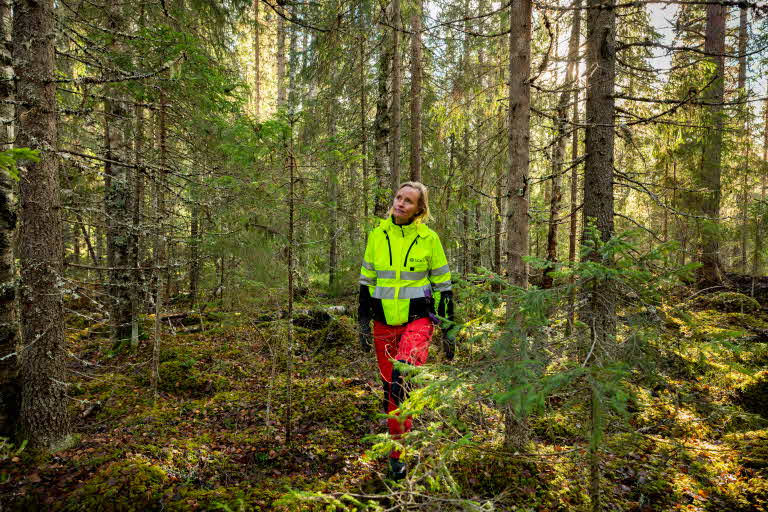
Forest with combined targets – continuous cover methods
In certain forests we can combine forestry with measures that preserve or develop nature values. We call it forests with combined targets. In these forests we have several goals, as preserving habitats while harvesting some timber. We manage them with continuous cover methods, which is a good complement to clear-felling.

Some forests with moderate to high conservation values are managed with combined targets. In these cases, the primary goal is to preserve the conservation values. This means we can harvest some timber while preserving or enhancing the existing conservation values. We manage around six percent of our forests holdings with combined targets.
These forests are managed using continuous cover methods such as selective cutting or selection system (gap cutting). In this way, we ensure that no large open areas are created.
In many cases, these measurements can beefit the reindeer husbandry. For example we can make extra large conservation area och wider buffer zones in areas rich in hanging lichens.
Continuous cover methods
– a good complement
Although SCA does not view continuous cover methods as a main alternative in our forestry, they are a good complement in selected areas. We use continuous cover methods primarily in areas where we are focused on developing biodiversity or where we want to shape beautiful forests that are pleasant to visit. Continuous cover methods are excellent for these purposes. However, if we were to transition entirely to continuous cover methods, our wood production – and consequently our climate benefit – would be dramatically reduced.
Continuous cover methods have been around for a long time, for example, selection cutting system was practiced as early as the end of the 19th century. However, the methods were often used incorrectly, which resulted in many sparse remnant forests without older trees. As a consequence, clear-felling took over.
SCA has been using alternative methods for 20 years, but we will increase the scope of these in the future. We also provide several areas of land for continuous cover field trials that both SLU and the Swedish Forest Agency are conducting. Some trials were established as early as the 1970s and 80s, while others were started in the 2000s.
Not suitable for all forests – lower growth
Continuous cover methods are better suited to some forests, while they are not suitable at all to other forests. A compilation of research* shows that continuous cover forestry results in approximately 20 percent lower growth than clear-felling forestry. This would result in an equally large loss in carbon absorption from the atmosphere and a reduced supply of products from the forest.
If all forests, which are currently mainly managed with clear-felling, were to be converted to use continuous cover methods, growth would decrease by more than 20 percent during the conversion phase.
* Hannerz, M., Arnesson Ceder, L., Eriksson, A. & Lundmark, T. Forest and Climate – what does research tell us? Rapport Skog 2024:1. Ver. 2. Swedish University of Agricultural Sciences.
Continuous cover methods
Continuous cover methods are used to manage the forest without creating large bare areas. SCA sees the methods as a complement and uses them primarily when the focus is on goals other than wood production and profitability.
