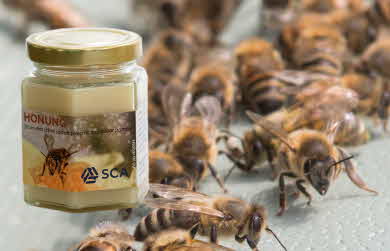
The beehives contribute to the survival of the Nordic honey bee
In Galtström, the honey is produced by the Nordic bee. The species has a great ability to adapt to low temperatures and changing weather conditions. It is therefore well suited to the climate of northern Sweden. The Nordic honey bee is highly endangered. Rescue efforts are underway, and the beehives contribute to the species’ survival and thus to biodiversity.

In Galtström ironworks, bees produce honey of the highest quality. The honey is generally harvested twice, the first time around midsummer and then at the beginning of August. In early spring, the bees find pollen and nectar from willow and sallow. In early summer, the nectar from lingonberry, blueberry and raspberry flowers lends its flavours and colours to the honey.
Later – when the summer is ripe – the milkweed (sw Rallarros), which grows along the railway embankment, in forest clearings and along the roadside ditches, is an important source of nectar in good company with the heather. The honey of late summer is more aromatic and has a darker colour.
During the second half of the 20th century, the Nordic bee began to be displaced by imports and crossbreeding with other bees. Nowadays, Nordic bee colonies only exist in a limited number of areas in the world. Rescue operations are underway in several countries and the hives in Galtström contribute to the survival of the species and thus to biodiversity.
A colony of Nordic bees can collect raw materials for up to 30 kg of honey in a hive during

a season. Once in the hive, the nectar is transferred between the bees, a process in which enzymes from the bees are mixed in, to break down the sugar in the nectar into simpler arts of sugar such as fructose and glucose. The bees then fan away water with their wings to concentrate the honey, which is stored until it is ready and can be covered with a wax cap.
Life in a bee colony follows an annual cycle, with intensive work periods during the summer and a winter period when the bees stay together in a so called "winter ball" to keep warm. There are different types of bees in the colony, a queen, a few thousand bee drones (male bees) and tens of thousands of worker bees. The queen is the only fertile female in the colony. She lays up to 2,000 eggs per day during the summer and maintains the unity of the colony through scents (pheromones). Worker bees are sexually mature female bees that perform all the tasks in the hive. They clean, build honeycombs, The drones’ sole function is to fertilize a new queen.
The “nuptial flight” is a mating flight that a young queen bee makes once in her life. During the nupital flight she is fertilized by about 20 drones. She attracts drones from different hives with pheromones, and mating takes place at high altitude. The drones die immediately after mating, while the queen saves the sperm in her “spermatheca” to be able to lay eggs for the rest of her life. In the queen's choice, she lays unfertilized eggs that become drones or fertilized eggs that become worker bees.
A queen bee can live up to five years. When she gets old and her egg production decreases, the bees can swarm. Then the old queen leaves the hive along with some of the worker bees to form a new colony. At the same time, the bee colony raises a new, younger queen in the original hive who takes over the role.
To keep the colony strong and productive, many beekeepers replace their queens every two or three years to avoid swarming.