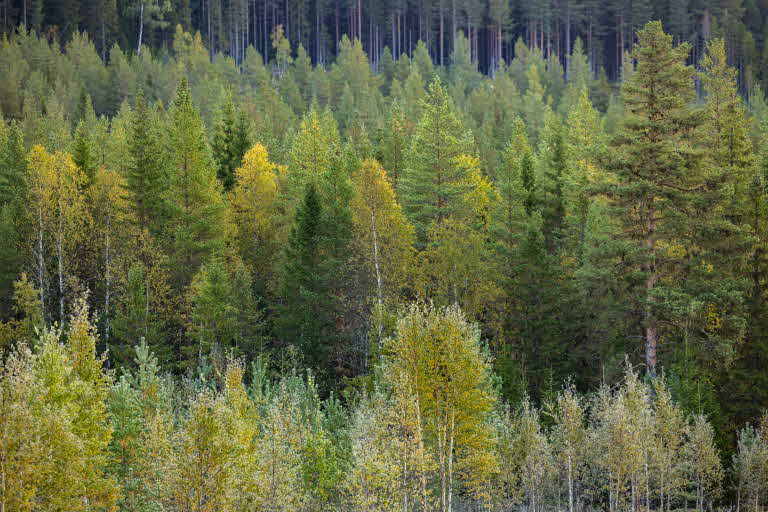
Tree species in our forests
Our forests are actively and sustainably managed to increase growth, and today we have approximately 277 million cubic meters of forest on our land. Swedish pine is the most common tree species, followed by spruce, deciduous trees, and lodgepole pine.
Thanks to our long-term and careful forest management, we have vital forests that grow well. In fact, we’ve never had as much forest as we do today, which benefits both our operations and the climate. For every harvested tree, we plant at least two new ones.
Trees in northern Sweden grow slowly, producing top-quality raw materials that we use to manufacture pulp, kraftliner, and sawn timber products. Northern wood fibers offer excellent strength properties, making them suitable for products requiring high strength and quality. The wood also has a high proportion of heartwood and small knots, making it ideal for visible wood applications and other wood products with strict quality requirements.
Tree species in SCA's forests
Swedish pine accounts for 39 percent of our land. It is followed by spruce at 37 percent, deciduous trees at 14 percent, and lodgepole pine at 10 percent.

Spruce

Pine

Deciduous trees

Lodgepole Pine
Lodgepole pine (Pinus contorta) is a Canadian tree species that grows 40 percent faster than Swedish pine when planted on comparable soil. It is considered an exotic tree species. For several years now, SCA has been sawing lodgepole pine timber, and the sawn wood is used for studs, panels, and decking. The timber is also well-suited for production of pulp and kraftliner.
Tree species determine the conservation measures
The best way to protect and enhance nature values depends entirely on the specific nature values and the type of forest involved. In northern Sweden, the main tree species are pine, spruce, and deciduous trees such as birch and aspen. Different tree species require specific measures to develop nature values and support various species.

Pine forests

Spruce forests

Deciduous forests
Read more about

Forest and forestry – a history look back
In order to understand the way SCA works with forestry and biodiversity today, we need to look back through history.

SCA's contorta pine forests
The contorta pine is a Canadian tree species that grows 40% faster compared with Swedish pine on the same land. SCA has about 300,000 hectares of contorta pins. This corresponds to 15 percent of SCA's productive forest land.

Clear-felling forestry – an eternal ecocycle
Clear-felling forestry means that we manage the forest in a perpetual cycle, where new forest are being planted to grows when the mature one has been harvested. The cycle time is approximately 60 to 120 years.