
SCA is reporting the lowest damage level ever to known archaeological and cultural remains, with a total of 1.4 percent damage overall. This goes against the grain of the industry at large as the Swedish Forest Agency announced that the percentage of damage to remains has increased, reaching the level of 18 percent in 2025.
Cultural environmental considerations
The concept of cultural environmental consideration in the forest includes ancient and other cultural historical remains. These are traces left by previous generations and are important to protect. Examples include hunting pits, charcoal production sites, and tar extraction pits.

Unfortunately, damage to these remains still occurs during forestry operations, especially during soil scarification. For several years, SCA is actively working to minimize such damage aiming for a zero-damage vision.
These efforts have yielded results, and the level of damage has decreased significantly in recent years. In 2025, SCA reached its lowest level ever, with damage at just 1.4%. This can be compared to the forestry industry as a whole, which reported 18% in damage during 2025, according to a follow-up by the Swedish Forest Agency.
All known ancient remains and other cultural-historical sites are registered by the Swedish National Heritage Board and are available in SCA’s map system. However, there are many remains that are not yet documented and can be difficult to detect. If an unknown site is discovered during forestry activities, it is reported to either the Swedish Forest Agency or the County Administrative Board.
Right in every action
In our work to protect these cultural sites, we emphasizes the importance of maintaining the so-called "cultural chain" throughout every step of the process. Everyone involved—from site planning, production, to forest management—needs to act appropriately.
For instance, anyone planning a harvesting operation must always check if the planned area contains any known ancient or cultural remains. They must provide clear instructions to the harvesting team and the soil scarification operator. Often, it is advisable to harvest the trees surrounding a cultural remain to make it visible and prevent damage from falling trees. However, it is essential to avoid driving over or damaging the remain.
Consideration stumps for protection
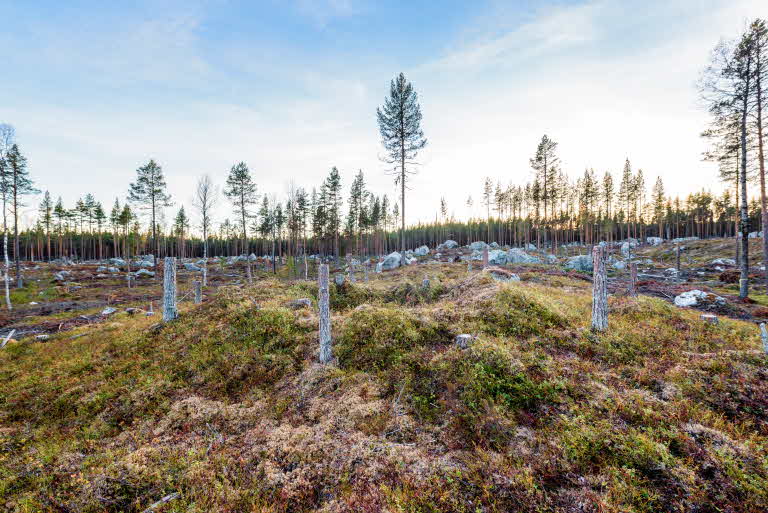
To mark and safeguard a site, SCA uses so-called consideration(culture) stumps, which are 1.3 meters high, placed around the heritage site. If there aren’t enough trees suitable for becoming stumps, or if the trees are in unsuitable locations, we use stakes instead. This ensures additional protection during soil scarification, preventing damage to the site.
Warning system

Photo: Michael Engman
SCA was the first in the Swedish forestry industry to implement a warning system in the forestry machines to protect ancient and cultural remains. Thanks to this system—featuring a flashing light linked to the digital map in the machine’s onboard computer—the operator is alerted when the machine approaches a remain.
The warning system applies to all known remains that are included in the map layer, as well as remains identified by SCA’s site planners before regeneration harvest. However, unknown remains is still risk damage. To mitigate this risk, SCA has updated its guidelines for areas with known remains.
From now on, soil scarification in these areas is only allowed during daylight hours, or the operator must scout the area in daylight. This increases the chance of detecting and protecting any previously unknown sites that might not have been identified by the site planner or logging team.
Annual follow-up
SCA follows up on its efforts to protect archaeological and cultural heritage sites on an annual basis.

Legal protection for remains
A distinction is made between ancient remains and other cultural-historical remains, with the primary difference being their age. The Swedish Heritage Conservation Act sets 1850 as the dividing line. If a site is older, it is classified as ancient remains.
Ancient remains are protected under the Swedish Heritage Conservation Act and must not be altered or damaged. The legal protection for ancient remains is strong, meaning that even those that are not yet discovered are protected. Ancient remains also include an associated protection zone or conditional area that is larger than the actual site. Typical examples of ancient remains include prehistoric graves, runestones, hunting pits, and old settlements.
Other cultural-historical remains are protected by the Forestry Act. According to the law, damage must either be completely prevented or minimized as far as possible without significantly hindering the ongoing land use. Examples of cultural-historical remains include charcoal production sites, tar extraction pits, trails, and the foundations of buildings from later periods.
Read more about

Gentle Effective Logging protects soil and water
It is vital that our harvesting operation does not cause any damage to soil or water. Therefore we work with the Gentle Effective Logging-method. This helps us reduce soil damages and also to improve work efficiency.

SCA's nature conservation palette
Our nature conservation palette encompasses the tools we use to work with conservation and consideration. This includes for example setting aside forests for natural development, and implementing active and making active and specific measures to benefit sensitive species. Another important tool is the basic retention we apply during all our forestry operations.