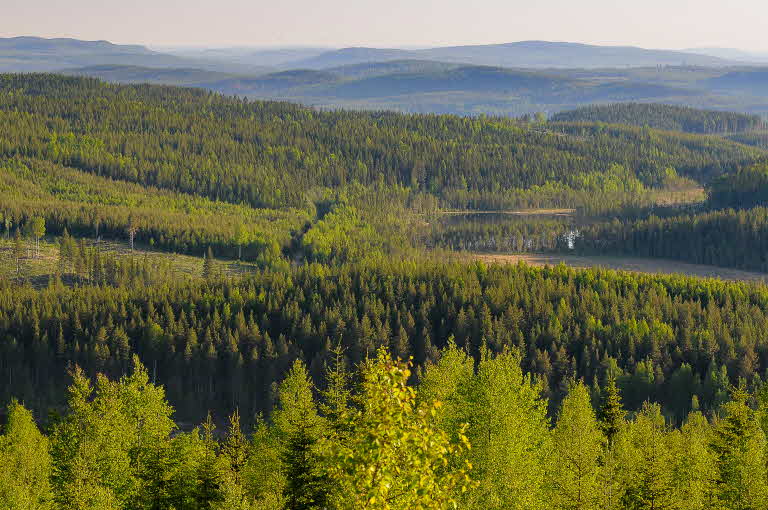
Managed forest
Most of SCA's forests are actively and sustainably managed to increase growth over the long term. Today, the volume of living trees on our holdings is larger than ever, amounting to approximately 277 million forest cubic meters. This is possible thanks to our forest management over more than seven decades. High growth benefits both our operations and the climate.
The high and stable forest growth is an essential part of our forestry because it ensures the availability of renewable raw materials, while it also can contribute to increase climate benefits and creating conditions for jobs and welfare. It also support biodiversity and offering nature experiences. The abundance of wood on our lands is a result of our active way of managing our forests.
Efficient forestry
We manage the majority of our forests using clear-felling (even aged system, known as trakthyggesbruk), a method that is both efficient and facilitates high growth of renewable raw materials. Clear-felling is the most common method in Swedish forestry as in the Nordic region and in the rest of the world.
The method involves dividing the forest into sub-areas, that are managed according to a cycle of recurring regeneration, precommercial thinning, thinning, and final harvesting. Forests are harvested when they are mature and replaced with a new generation of trees.
With today's practices, clear-felling forestry works excellently in combination with considerations for biodiversity and the forest's other values.
Growing slowly
Forests in northern Sweden grow slowly. The significant advantage of this is that the timber quality becomes exceptional, which is appreciated by many customers. However, the downside is that it takes a long time to produce timber. The trees in our forests grow for about 65 to 120 years before they are ready for harvesting. Despite the long waiting period, the trees in the north are notably smaller when ready for harvest compared to those growing in more southerly areas.
More wood than ever
We began systematically measuring our forests in 1947, when we conducted our first company inventory. Within 100 years from then, around 2025, we will be abled to double the standing timber volume (the volume of living trees) on our lands. During the same time, we will manage to triple the harvesting level.
SCA has never had as much wood as it does now and the standing timber volume is expected to grow over the coming decades. The red lines show inventories conducted by SCA. The figures are forecasted from 2020 according to the latest inventory..
Good forest management has gradually increased the sustainable harvesting level since the late 1940s. Over the next 10–20 years, it is expected to be able to increase even more. The graph is based on the most recent harvesting calculations performed in 2020.
Active forestry for more wood

The doubling of the standing timber volume is a result of actively managing our forests. One key measure in our forestry practices is that we plant at least two seedlings for every tree harvested. These seedlings come from our own nurseries and are genetically improved, meaning they grow better.
Every year we plant around 50 millions seedlings in our own forests.In the same time we also supply other private forest owners with the same amount of seedlings. In fact, every fourh seedling plnated in Sweden comes from SCA!
Today's improved seedlings yield forests that grow up to 25 percent better compared to non-refined forests. They also produce higher timber quality and have greater resistance to various diseases. In addition, the seedlings are better equipped to handle climate change.
Other important measures in forestry include timely pre-.commercial thinning and thinning of the forests. We also fertilize certain forests and plant fast-growing lodgepole pine (contorta pine) in suitable areas.
We have never had a larger standing timber volume than we do now, and through active management, it will continue to grow. When managed properly, the forest becomes an endless resource.
No large bare areas
Using clear-felling forestry does not mean that we creat large bare areas. Nowadays, regeneration areas are significantly smaller than they used to be. Additionally, we leave 10–15 percent as natur consideration.

Harvested area in the 1970s.

Harvested area 2025

Facts & figures 2025
2.7million hectares
forest holdings 2million hectares
productive forest land 5.4million cu.m
annual harvest SCA's Swedish forests 19,000hectares
thinning in SCA's Swedish forest 76,800hectares
silviculture SCA's Swedish forest 93.2million
seedling deliveries

High net growth

No deforestation in Sweden
Reaad more about
Basic retention in every measure
Regardless of what measures we take in our forestry, we always take into account biodiversity, cultural environments, outdoor life and reindeer herding – we call it environmental consideration or basic retention. The most extensive consideration is taken during regeneration harvest.

Nature conservation and consideration
To ensure biodiversity in the forest, a variety of habitats are needed. We use a wide range of tools to achieve this. For instance, we leave extensive consideration areas during harvesting, voluntary set-aside to develop freely, and carry out active measures to benefit different species. Follow-ups show that our efforts are yielding results.

Forest & climate
Limiting global warming is one of the greatest challenges of our time. As a forest company, we see ourselves as one part of the solution. First as trees in our forests grow and capture and bind CO₂. Then as our forest raw materials are turned into products that replace those that leave a broader carbon footprint. In this way, oil and coal can remain underground.