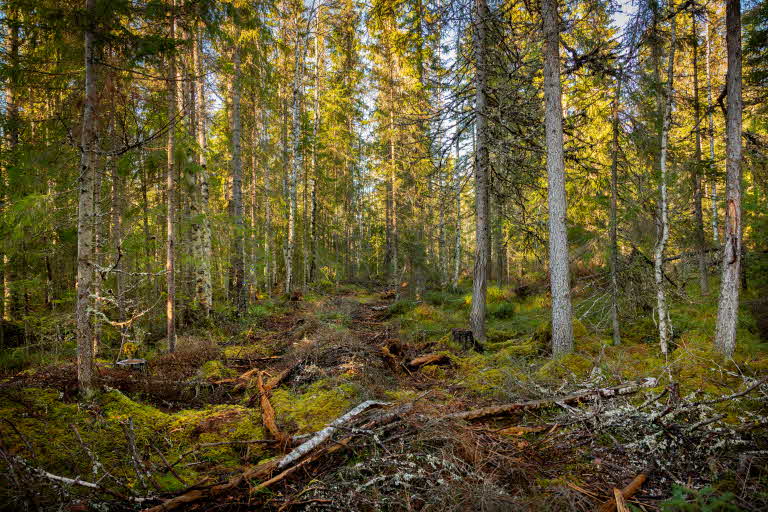
Continuous cover methods are used to manage the forest without creating large bare areas. SCA sees the methods as a complement and uses them primarily when the focus is on goals other than timber production and profitability.
With continuous cover methods there is always standing trees left in the area, preserving the feeling of a forest.
The goal of continuous cover methods can, for example, be to benefit naturevalues, such as species that depend on moisture and shade, or to benefit deciduous trees, which are in short supply in today's forests. Swamp spruce forests and sand pine forests are examples where continuous cover methods are of great benefit to biodiversity.
The methods can also be good when we want to preserve social values in, for example, a mountain pasture environment. They are often also suitable when we want to create extra beautiful forests that are pleasant to stay in.
Lower growth
In the debate about forestry, continuous cover methods are often highlighted as an alternative, but these methods give significantly lower growth on most land. A compilation
A spruce forst with trees in all ages makes it possible to use selection cutting.
of research* shows that continuous cover forestry gives approximately 20 percent lower growth than clear-cutting forestry at the landscape level. For individual stands that are managed with some form of continuous cover method, the variation can be much greater.
And if all forests that are currently mainly managed with clear-cutting were to be converted to no-clearing, growth would decrease by more than 20 percent during the conversion phase.
A transition to continuous cover methods would also entail an equally large loss in terms of carbon absorption from the atmosphere and a reduced supply of products from the forest. When discussing continuous cover methods, it is therefore important to also include questions about the forest's contribution to the climate transition in the reasoning.
Based on natural regeneration
One of the main reasons why growth is lower with continuous cover methods is that they are based on natural regeneration. This means that regeneration becomes more uncertain. Regeneration becomes particularly problematic for forests in harsh climates.
It is also not possible to use the benefits of improved seedlings, which is possible when planting. Improved seedlings grow up to 25 percent better than seedlings that have been self-rejuvenated. They also have higher quality and better resistance to various diseases.
There are also other disadvantages of continuous cover, such as increased risk of windfall, root rot and insect infestations.
*Hannerz, M., Arnesson Ceder, L., Eriksson, A. & Lundmark, T. Forest and Climate – what does research tell us? Rapport Skog 2024:1. Ver. 2. Swedish University of Agricultural Sciences.
Continuous cover methods
SCA applies three principal methods: Selection cutting, gap harvesting and broadleaf harvesting including shelterwood syste,. The Swedish Forest Agency does not always classify broadleaf harvesting as a continuous cover method, but it is an alternative approach to clear-felling forestry. These principles make a good foundation to combine and adapt to the specific forest.
Selection cutting
A selection cutting forest should preferably have a multi-layered structure, meaning it contains trees of all sizes – from seedlings to old trees. In this method, only the thickest trees are harvested, while the younger, smaller trees are left to grow until they reach sufficient thickness.
When using selection cutting, the ground is always forested, and the forest maintains a consistent appearance over time, benefitting the flora and fauna that are sensitive to significant changes in their habitat. Some trees are also allowed to grow very thick and old, which supports species that depend on mature, thicker trees. Various hanging lichens, for example, tend to thrive in selection cutting forests, as they can spread from older trees to younger ones. Selection cutting also preserves the feeling of being in a forest – you rarely see from one strip road to another.
Selection cutting is best suited for tree species adapted to shade, which is why it is primarily spruce that can be harvested this way in northern Sweden. The area must also have a relatively high timber stock for selection cutting to function effectively and ensure good regeneration.
Harvesting: Is done periodically, approximately every 15–30 years. The longer interval applies if the forest grows slowly, while the shorter interval applies to faster-growing forests. The timber extraction typically amounts to 25–30 percent of the volume during each harvest. During the first harvest, permanent strip roads are created within the stand. For subsequent harvests, the same roads are reused, and the thickest trees beside them are removed. Timing: Harvesting can be done at any time of the year, but it is important to consider the ground conditions. Wet areas, for example, may need to be reserved for winter harvesting to avoid soil damage. Regeneration: Regeneration occurs naturally since there are always trees of all ages growing within the area. This eliminates the need for investments in soil scarification and planting.
Gap harvesting
Gap harvesting involves creating small openings – gaps – in the forest area to encourage regeneration within these gaps. The method is primarily suitable for pine and desiduous forests but can also work in mixed forests with spruce. With gap harvesting you create small openings – gaps – in the forest area to encourage regeneration within these gaps. The gaps can be shaped either as squares or circles. According to the Swedish Forest Agency's definition, each gap can be a maximum of 0.25 hectares, although they are often made smaller. The size of the gaps depends on the characteristics of the forest and how much sunlight is needed to reach the ground. Compared to clear-felling, gaps make the forest less vulnerable to wind, as the remaining trees provide mutual protection. Gap harvesting also preserves the feeling of being in a forest and offers small open areas between forested sections. It allows more sunlight while creating a pleasant forest environment to enjoy.
Harvesting: Up to 50 percent of the timber volume can be harvested. As regeneration develops within the gaps, the standing forest can then either be fully harvested or gradually expand the gaps to create a more uneven-aged stand. Timing: Harvesting can be done at any time, but it is essential to consider soil conditions. For instance, wet soils should be harvested in winter to avoid soil damage. Regeneration: Regeneration occurs within the gaps, either naturally or through planting or seeding. Often, some form of soil scarification is necessary to create favorable conditions for regrowth. The size of the gaps plays a crucial role, as larger gaps provide better opportunities for regenerating light-demanding tree species like pine and broadleaf trees.
Broadleaf harvesting and shelterwood system
In broadleaf harvesting, broadleaf trees and occasionally pines are saved while most spruces are removed. This benefits biodiversity and species associated with deciduous trees. SCA often uses shelterwood felling to preserve broadleaf trees. The Swedish Forest Agency does not always classify broadleaf harvesting as a continuous-cover method, but it is an alternative to clear-felling. Similarly, shelterwood system is not typically considered a continuous-cover methods, though in some cases, they might be. The Swedish Forest Agency refers to this approach as “retained shelterwood”.
Broadleaf harvesting
In broadleaf harvesting, broadleaf trees and, preferably, pines are retained while most spruces are harvested. This benefits biodiversity and species associated with broadleaf trees, such as many birds and insects. The method is often used near residential areas, resulting in a bright, open and pleasant recreational forest that is enjoyable to visit. Harvesting: Primarily spruce timber is harvested, although in some cases, a portion of pine timber may also be harvested. Timing: Harvesting is typically done in autumn or winter to avoid disturbing birdlife during the spring and summer months. Regeneration: It depends. If harvesting exceeds the threshold that legally requires reforestation, planting seedlings becomes necessary. Successful natural regeneration of broadleaf trees often requires some form of soil scarification to ensure good growth conditions for the seedlings.
Shelterwood systems
This method involves thinning a stand to create a canopy of large trees, under which new trees are encouraged to grow, either naturally or through planting. it is most suitable for tree species that require abundant light for regeneration, such as broadleaf trees and pine. To maintain the feeling of being in a forest, trees in a continuous-cover shelterwood are kept denser than in a typical seed tree system. The canopy is also retained for a longer period, but once the new stand has matured, the shelter can be gradually removed. At that point, a few ecological retention trees are left to continue growing and eventually die naturally within the area.
It is important for a shelterwood stand to be sufficiently thinned to allow enough light for successful regeneration. The density of the canopy depends on the stand's ability to regenerate. A forest with a shelterwood system offers good visibility and is enjoyable to move through, as it feels open and bright. While shelterwoods can also be applied to spruce, they become significantly more susceptible to wind damage. In low-lying terrain, such as spruce swamp forests, shelterwoods can function effectively.
Nature considerations in continuous cover forestry
Even when using continuous-cover methods, it is essential to take environmental considerations into account, as the method itself is not sufficient on its own. Even if a large proportion of the trees are left standing, it is often not enough to meet the requirements for nature conservation. Continuous-cover methods often involve harvesting the largest, thickest, trees, but some of these should be retained to allow them to grow very old and die naturally. This is important for biodiversity.
In a selection cutting, for example, some of the largest trees should be left to reach an advanced age, eventually dying naturally. Dead standing trees and some fallen trees should also be left, ensuring there is always wood at various stages of decay. When it comes to gap harvesting, it is important to preserve retention trees within the gaps. Regardless of the method, it is always crucial to leave older trees and tree clusters, as well as dead wood and future biodiversity trees.
In September, SCA hosted a field excursion for the Collaborative Group for Continuous-Cover Forestry in Southern Norrland. The group visited four sites where SCA has applied different continuous-cover methods.
Planning is crucial to balancing the many values that coexist in our forests. By analyzing our forest holdings from a landscape perspective and over a long period of time, we can identify which forests have the highest nature values and which can be managed with a focus on timber production. In addition, careful planning is carried out before each individual harvest.
Dead wood and old forest are a few examples of indicators for biodiversity in the forest. This means they represent important factors to ensure a diversity of species. SCA tracks the development of five key indicators in our holdings over time and the result has been very positive. The different indicators have risen by about 25-90% in a relatively short period.