Parts of the wetland area before the restoration measures. In the lower part of the image, an area of vegetation-free peat is visible, among other features.
150 hectares of wetland re-wetted in Västerbotten
- News
- Forest
- Sustainability
Over the past year, SCA has blocked ditches across a 150-hectare wetland area in Lycksele Municipality. In total, around 15 km of century-old ditches have been restored with funding through LONA. “We can already see positive effects of the re-wetting, with beautiful pools of water that benefit biodiversity,” says Ulf Hallin, Nature Conservation Specialist at SCA and the person responsible for the restoration.

The area is located near Toskbäcken in the western parts of Lycksele municipality. It was manually drained with shovels between 1915 and 1928, with the aim of creating more arable land for agriculture.
“Back then, there was also a belief that drainage could remove cold air,” Ulf explains. “But the result here was probably only a marginal increase in arable land and hardly any improvement in growing conditions. Instead, the ditches contributed to some afforestation of what had previously been open wetland. In addition, the peat in the more drained parts of the wetland began to break down after drainage, creating more uniform habitats.”
Dedicated work
For several years, SCA has been working in a dedicated way to restore selected wetlands that were previously drained, with the aim of re-wetting them. Wetlands are also a priority area for the Swedish government, which wants to see more restored wetlands.
“Since these ditches no longer serve any purpose and are also harmful to biodiversity, greenhouse gas emissions and the water cycle in the landscape, we considered the area suitable for restoration,” says Ulf.
Raised water levels

The excavator used to fill in the ditches is equipped with wide tracks, giving it low ground pressure
Using an excavator, the ditches were filled in, partly completely and partly with peat dams to prevent a water channel from re-forming in the old ditch. By using peat from the mire, it is possible to create effective plugs that limit drainage and help keep water in the area.
“One year after our measures, it is clearly visible that the water level in the area has risen, which is great to see. It means we get a greater variety of habitats, which benefits birds, insects and certain plants,” Ulf explains, adding:
“As the area is refilled with water, carbon dioxide emissions decrease. At the same time, a re-wetted wetland can improve its function in cleaning precipitation of airborne pollutants before they reach watercourses and lakes.”
Photo: Ulf Hallin
The wetland - before and after SCA's measures


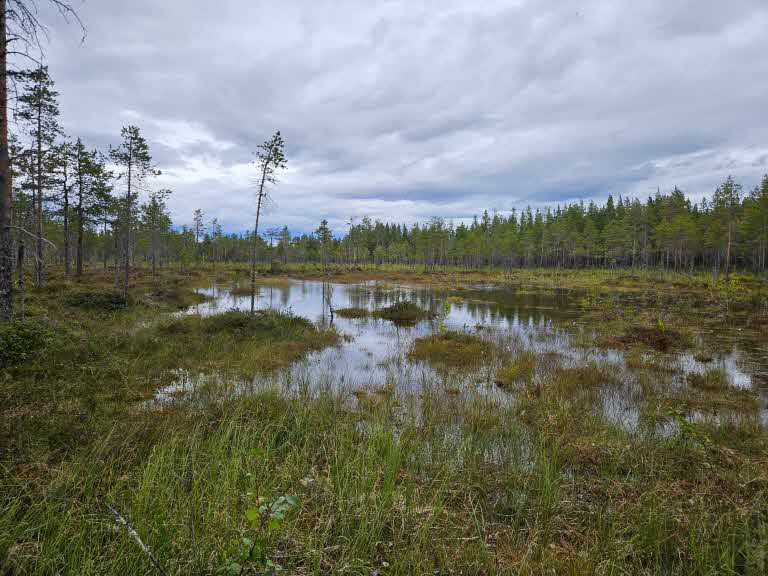
Same area as in the photo on the left, in August 2026 approximately one year after the intervention. It is clearly visible that the previously vegetation-free peat has now been rehydrated, which means there are conditions for vegetation to re-establish there. The small tarn in the northwest has been only marginally affected, as the ditch next to it could not be backfilled by the excavator.

Another part of the wetland before restoration. At the top of the image, a tarn can be seen, partially drained through the wetland, along with a main ditch and several side ditches cutting across the wetland.

August 2026, approximately one year after the restoration measures were carried out. The image shows the same area as the photo in the left. The ditch in the middle of the photo has now been filled in, and the ditch plugs have created recurring pools of water.
More information

Over 1,100 hectares of wetland restoration on SCA land
Since 2021, SCA has been dedicated to restoring selected wetlands on its land. This includes both restoration projects managed directly by SCA and those conducted in partnership with others, where SCA acts as the landowner. Thanks to these efforts, we have now surpassed over 1,100 hectares of wetland restoration.

Protecting wetlands and watercourses SCA
Protecting waterways as well as restoring and preserving wetlands is an important part of our forestry.

Positive changes after wetland restoration
New wetland species along with a wetter mire. These are some of the changes observed following SCA’s restoration of Stentjärnsmyren in Medelpad, according to an inventory conducted by BirdLife Medelpad. "It’s cautiously positive signs, even though we can’t say that it’s entirely a result of the restoration," says Bengt Allberg, BirdLife Medelpad.
Latest news on this topic

Continuous-cover forestry excursion in SCA’s forests
In September, SCA hosted a field excursion for the Collaborative Group for Continuous-Cover Forestry in Southern Norrland. The group visited four sites where SCA has applied different continuous-cover methods.

SCA and Sami villages met in field excursions
During August, SCA carried out field excursions Älvsbyn and Strömsund with Sami villages that we coordinate our co-planning with. Interest in the meetings was high, and more than 30 reindeer herders from 15 Sami villages took part.

SCA land host for major road project
The EU project Northern Traffic Lights aims to develop digital solutions that can monitor and predict the trafficability and maintenance needs of private gravel roads. SCA is participating as a land host in a project part led by Skogforsk, anh has now two advanced weather stations on its road network along tin northern Sweden.