Forestry and reindeer husbandry are conducted on the same land, which makes effective collaboration essential for both to operate side by side. SCA and the Swedish Sami Association (SSR) has signed an agreement. The purpose is to strengthen cooperation and develop working methods that improve conditions for reindeer husbandry, while ensuring that forestry is conducted in a long-term and responsible manner.
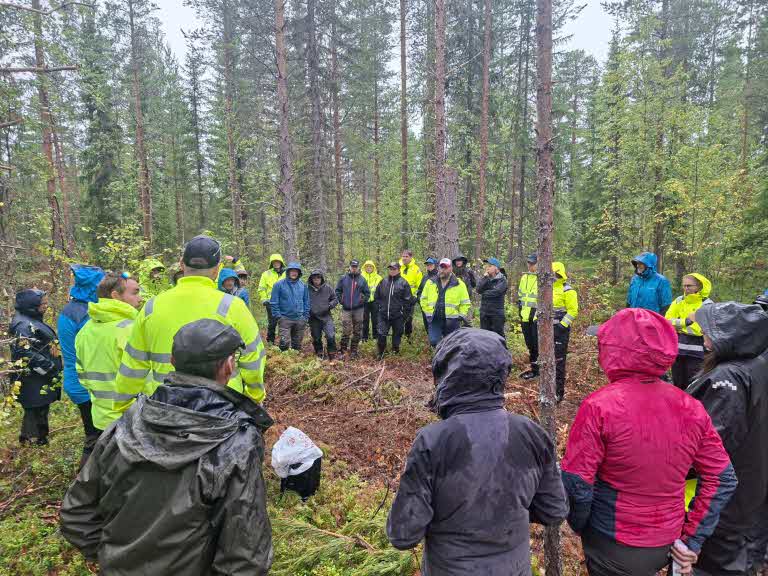
SCA and Sami villages met in field excursions
- News
- Forest
During August, SCA carried out field excursions Älvsbyn and Strömsund with Sami villages that we coordinate our co-planning with. Interest in the meetings was high, and more than 30 reindeer herders from 15 Sami villages took part. “It was great that we were so many, since the purpose of the meetings was to deepen understanding between our operations and try to learn from one another”, says Anna Westerlund, forest specialist.
Normally, FSC Sweden hosts an annual field excursion between forestry companies and Sami villages, but this year they were unable to do so. Anna Westerlund and Håkan Sars, SCA’s two specialists focusing on reindeer husbandry issues, then took matters into their own hands.
“We decided to arrange two meetings because we believe it is very valuable to meet in the forest and discuss needs, measures and challenges”, says Anna.

In Strömsund, the group discussed pre-commercial thinning in a stand located close to a gathering enclosure and an area that is important to the Sami village. The discussion concluded that early light penetration into the stand is necessary to benefit the ground lichen. This shows how important dialogue is when deciding where reindeer husbandry-adapted measures should be carried out.
Met on grazing lands
In Älvsbyn, the field meeting was held on the Luokta-Mávas Sami village’s winter grazing lands, and in Strömsund the group met on the winter grazing area of the Ohredahke Sami village.
“It was good that we could arrange the excursions together with the Sami villages, so that they could describe how they use the landscape we were in and explain what is important to them and what challenges they face in their daily work”, says Håkan.
In addition to the Sami villages, researchers from SLU and Umeå University were also invited, as well as the Swedish Sami Association (SSR), SCA’s forest management representatives and specialists in nature conservation and forest management.
“The researchers contributed the latest findings, Håkan adds. Among other things, they explained how pre-commercial thinning and thinning affect ground lichen, what is happening with the so-called ground lichen map, and what research is currently underway.”
Discussed measures

In Älvsbyn, fishing sticks were used in to measure the number of stems in a young forest stand. The group discussed how the stand should be managed in future measures to meet both forestry’s need to produce sawlogs and reindeer husbandry’s need for grazing.
During the meetings, the group visited a number of forest stands where exercises and discussions were aimed at highlighting how they create value for reindeer husbandry.
“We discussed which measures may be appropriate to implement and also evaluated some measures that have already been carried out”, Anna explains.
Coordinated planning includes, among other things, final felling, roads, planting material (including contorta pine) and soil scarification methods. The discussions focused heavily on how SCA can create more usable landscapes for reindeer and facilitate reindeer husbandry in terms of moving herds and monitoring them.
“This includes, among other things, how we preserve and manage lichen-rich areas and how we can reduce the negative effects of overly dense stands, where we place logging residue after thinning, and how we can adapt harvesting in older forests. Co-planning must be carried out from a landscape perspective, and therefore measures such as pre commercial thinning and thinning are also important to manage when we plan together, so that they are carried out in the right way and in the right places”, says Håkan.
Both pre-commercial thinning and thinning are measures appreciated by reindeer husbandry.
“They are positive for ground lichens and improve accessibility for both reindeer and reindeer herders”, says Anna.
Willingness to collaborate
The excursions show that there is a strong willingness to cooperate. SCA’s strategy for long-term collaboration with reindeer husbandry, presented this spring, supports cooperation and contributes to increased understanding and alignment between the parties.
“Many feel that it shows we have a high level of ambition and that we are at the forefront of the forestry sector. But it is far too early for the strategy to be evaluated in detail”, says Anna.
And of course, there are also differences of opinion and issues where the industries are not aligned.
“We can see, for example, that there are differences in views on the pace at which measures should or can be implemented, and which measures that have the best effect. Continued dialogue is therefore needed about what should be prioritised and where, says Anna. The use of contorta pine is also a point of contention, but it was not a prominent topic during the meetings.”
“We have also stated in our strategy that we will use contorta in a way that reduces its impact on reindeer husbandry, Håkan adds. An important part of this is to map, together with the Sami villages, areas of particular importance.”
No single solution
One of the most important lessons from the days is that adaptation for reindeer husbandry cannot be treated as a generic measure.
“No, there is no one solution that fits everywhere. We need to start from each Sami village and the function of their areas for the reindeer, and combine that with the variation in the landscape in order to determine which adaptations are feasible”, says Anna, and continues:
“SCA’s forest management in areas of major importance for reindeer husbandry needs to be more site-specific, more varied and have a clearer objective. Once that is in place, we have good opportunities to create better conditions for both reindeer grazing, lichens and forest production in the long term.”
The value of learning
Per Funkquist, SCA’s Sustainability Director and one of SCA’s representatives in the cooperation with the Swedish Sami Association, sees great value in the excursions.
“In our strategy for SCA’s long-term collaboration with reindeer husbandry, we highlight the value of learning and increased knowledge among both forestry actors and reindeer herders about how our activities affect one another. These field days are a good example of how we work in practice to strengthen dialogue and increase understanding. By creating a forum for discussion, we can come closer to one another and, in the long term, develop and improve how we can take reindeer husbandry needs into account in long-term forest planning”, Per concludes.
Top picture shows the group in Strömsund when they reviewed a thinning carried out with consideration for ground lichen. During the thinning, SCA avoided placing extraction routes where ground lichen is present and also avoided leaving logging residues on the lichen. In addition, we have slightly reduced the basal area in parts of the stand with a high proportion of ground lichen, meaning that we have thinned the trees a little more than usual to benefit the lichens.
More information

Responsible forestry
As a major forest owner, we are responsible for conducting forestry that balances many different values. This means that we combine a high level of renewable raw material production with extensive consideration for biodiversity, reindeer herding, outdoor recreation, and much more. Our conservation commitments often exceeds both legal and certification requirements.

SCA and Swedish Sámi National Association agree on long-term collaboration
SCA and Swedish Sámi National Association, the representative organisation for reindeer husbandry and Sámi business and community affairs, have signed an agreement aimed at strengthening cooperation between SCA, SSR and the reindeer husbandry sector. The agreement is intended to develop working methods that improve conditions for reindeer husbandry while ensuring that forestry is conducted in a long-term and responsible manner.
Latest news on this topic

SCA land host for major road project
The EU project Northern Traffic Lights aims to develop digital solutions that can monitor and predict the trafficability and maintenance needs of private gravel roads. SCA is participating as a land host in a project part led by Skogforsk, anh has now two advanced weather stations on its road network along tin northern Sweden.

SCA has re-wetted 150 hectares of wetland in Västerbotten
Over the past year, SCA has blocked ditches across a 150-hectare wetland area in Lycksele Municipality. In total, around 15 km of century-old ditches have been restored with funding through LONA. “We can already see positive effects of the re-wetting",says Ulf Hallin, Nature Conservation Specialist at SCA.

The world’s first electric timber truck has completed its run
The world’s first electric timber truck has completed its time on the road in SCA’s service. After four years and around 130 000 kilometers, the world’s first electric timber truck has now completed its time on the road. During the summer, SCA and Grundbergs Åkeri, which operated the truck, handed it back to Scania. The electric drivetrain has resulted in 220,000 kilograms lower carbon dioxide emissions.