
SCA is bringing its market and sales organization together under a common structure for Pulp and Containerboard, creating a clearer overall responsibility for sales and marketing across the business areas.
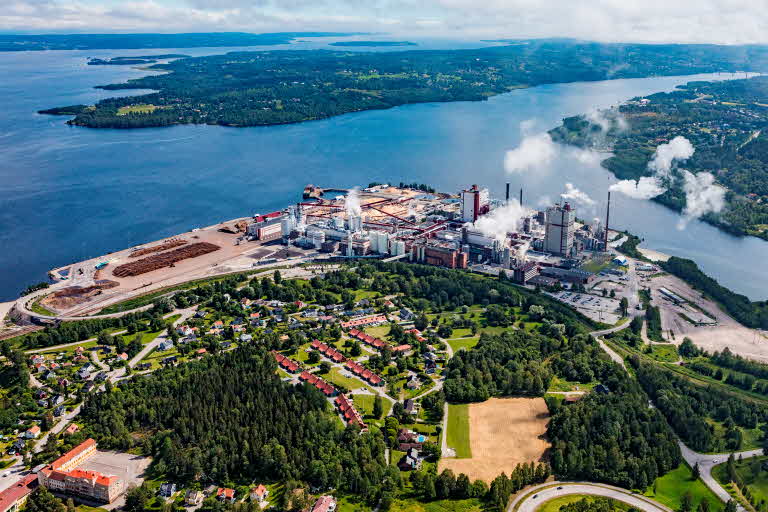
Östrand – the energy mill with power
- News
- Pulp
Did you know that Östrand’s pulp mill in Timrå produces around 220 GWh more electricity annually than Bergeforsen hydropower plant*? That is not what one would usually expect from a pulp mill. But at Östrand, forest raw material becomes not only pulp, but also large amounts of renewable energy. This makes the facility an important part of both industry and society’s energy supply.
SCA makes use of the whole tree, and it is the tops, branches and pulpwood that are used to produce softwood sulfate pulp. From this pulp, Östrand’s customers make packaging and hygiene products, among other things.
But the process also generates energy. In 2025, electricity production amounted to about 950 GWh and district heating production to 140 GWh. This corresponds to electricity for around 95,000 villas and heating for about 14,000 villas over the course of a year**.
Self-sufficient in energy
Although production requires a lot of energy, Östrand is largely self-sufficient in electricity and heat. In 2025, about 5,000 GWh of fuel and 500 GWh of electricity were used, and nearly 450 GWh of the electricity produced was delivered to the grid. The fuel comes largely from residual products in the process, such as bark, wood residues and black liquor. A full 95 percent of the fuel used is biofuel.
Resource efficiency in practice
What makes Östrand particularly notable is how raw materials and side streams are utilized. Waste heat is used as district heating in the local area, residual products such as tall oil, turpentine and sodium bisulfite are recovered, and closed systems reuse process water and chemicals. In addition, bleaching is carried out without chlorine gas. These are clear examples of resource efficiency in practice.
Contributing to a more flexible power system
This makes Östrand more than a producer of pulp, electricity and heat. The mill is also part of the power system’s balancing capability. Every megawatt of regulating power from bio-based industry is a megawatt that does not need to be kept in reserve in fossil form.
Östrand shows how modern industry can combine production, energy benefits and flexible grid balancing — while contributing to the transition to a more sustainable energy system.
* The Bergeforsen hydropower plant produces approximately 735 GWh of electricity per year.
** A typical detached house uses about 5,000–10,000 kWh of electricity and 10,000–20,000 kWh of heating per year. This means that Östrand produces electricity equivalent to the annual use of 95,000 Swedish homes, as well as heat for 14,000 Swedish homes. For comparison, there are about 4,700 detached houses and small homes in Timrå Municipality and about 18,000 detached houses and small homes in Sundsvall Municipality.
Photo: Per-Anders Sjöquist
Latest news on this topic

Reliable pulp supply
“In a somewhat turbulent and uncertain time, we want to be a stable, long-term partner that our customers can truly rely on for their raw material supply,” says Arvid Eriksson, Director Global Sales NBSK.

Improved tensile strength
“Since we started up our new mill, Östrand pulp mill, in 2018, we’ve been continuously working to improve strength properties. Now we’re seeing the results. In 2024, tensile strength reached 95 kNm/kg (at 25◦SR). Naturally, we’re pleased with this development, but we’re always striving to further improve our pulp quality,” says Jessica Sjöberg, Product Manager for SCA Pure (NBSK).