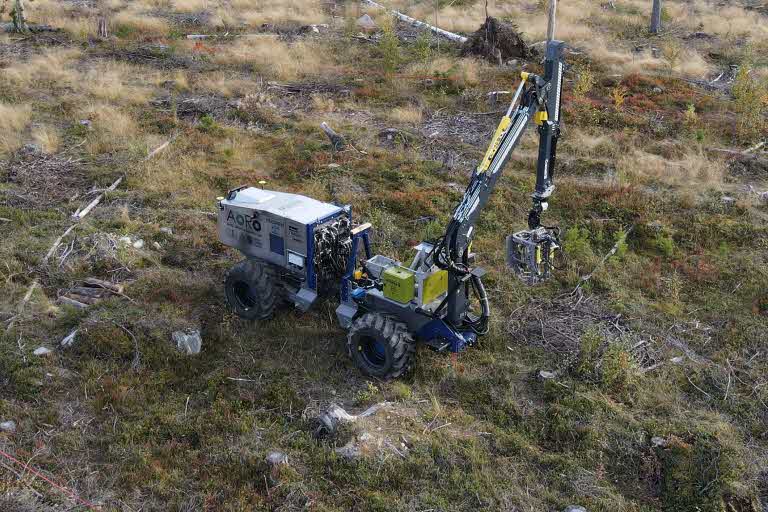
The Autoplant project - autonomous soil scarification and planting
During five years the cooperation projekct Autoplant has developed an autonomous systm for soil scarification and planting. Now, when the projects is terminated one of the major result is functioning prototype. A future machine could provide a better working environment and higher precision, and reduce environmental impact compared with currently used machines.

AutoPlant is a Vinnova-funded joint project that started in 2019 with the Forestry Research Institute of Sweden, SCA, Luleå University of Technology, the Royal Institute of Technology, Bracke Forest, Skogstekniska klustret, Södra, Sveaskog and Holmen.
The project team has been working on the development of subcomponents and then testing them in a research platform – a type of driverless test machine for soil scarification and planting. The idea is that the technique will provide a better working environment and higher precision, and reduce environmental impact compared with currently used machines.
The initiative for Autoplant comes from SCA and Magnus Bergman, Head of Technology and Digitalization at SCA Forest.
"We need to develop new, gentle and more effective methods for soil scarification and planting and we’re convinced that a smaller and autonomous forest regeneration machine is the way forward.” says Magnus Bergman.
Final Summary, September 2026
“Autoplant has been an important collaborative project, showing the power that emerges when research, technology companies and forestry work toward a common goal,” says Linnea Hansson of Skogforsk, who has served as project manager for Autoplant.
Skogforsk’s newly produced film presents the Autoplant system; see below.
New planting head and route planning
A vital part of the system is Bracke Forest’s new planting head, which both prepares the soil and plants autonomously. Under favorable conditions, the head can operate at speeds of up to two kilometers per hour. It is also scalable and can be equipped with 1–3 arms depending on the size of the base machine.
“We have gone from idea and concept sketches to a working prototype. It is an important step forward and gives us knowledge that will be valuable in the continued development of future machines for forest regeneration,” says Ruben van Westendorp, Development Manager at Bracke Forest.
Today, the attachment is pulled by a conventional forwarder, but in the long term it is intended to be pulled by autonomous machines of different sizes. The project has therefore studied terrain characteristics, energy consumption and productivity for different base machines. At the same time, a decision-support tool for automatic planting and route planning, “Pathfinder,” has been developed to enable autonomous operation.
“Pathfinder both helps the system select tree species based on what has grown best in that particular location, and provides route suggestions that avoid sensitive areas or areas where nature and cultural heritage values must be taken into account. Pathfinder can also be used in today’s soil scarifiers,” says Linnea Hansson.
Reduced ground impact has been a central issue, and follow-ups show that the soil scarification method used results in up to 80 percent less impact compared with conventional scarification. An automatic quality-control system for planted seedlings, based on image analysis and AI, has also been developed.
“A camera at the rear of the machine takes a picture of each seedling so that it can immediately be seen whether it has been planted properly or not,” says Linnea Hansson.
Laying a foundation
Autoplant has also addressed occupational health and safety, the interaction between humans and machines, and the laws and regulations required for the new technology to be introduced and commercialized. Taken together, the project has laid a foundation for continued development toward more productive, resource-efficient and sustainable forestry.

Autoplant Facts
- Collaborative project for autonomous site preparation and planting, part of Vinnova’s initiative for challenge-driven innovation.
- Funded by Vinnova and the participating parties.
- Carried out in three phases (initiation, implementation and deployment) from 2019 to 2026, with the project concluding on 11 September 2026.
- Project partners: Skogforsk, LTU, KTH, Bracke Forest, the Forestry Technology Cluster, SCA, Södra, Sveaskog, Holmen and Stora Enso.
A successful and efficient regeneration process is important for several reasons. Forests are needed to capture carbon dioxide and help reduce climate change, and it is therefore important that new forest is established quickly after harvesting. However, planting is physically demanding work and, in recent years, it has been difficult to find enough labour. Soil scarification is also important so that more seedlings survive and grow well, but this work must become more energy-efficient and gentler on the environment and on machine operators, as operators today are exposed to significant whole-body vibration.
Photo: Linnea Hansson, Björn Edlund, Gustav Sten