
2024 was a record year for pellet production at SCAs unit Bionorr in Härnösand. By using sawdust, a by-product from SCA’s sawmills, Bionorr has produced a renewable fuel with high energy value, enough to heat 57800 homes for a year. Additionally, the residual heat from the manufacturing process contributed energy to the district heating network in Härnösand, equivalent to heating 2600 homes.
SCA contributes to Sweden’s energy supply
- News
- Renewable Energy
How can Sweden become stronger – in everyday life and in times of crisis? Part of the answer lies in Sweden’s forests and in renewable energy production.
Sweden’s energy supply is based on several types of energy and raw materials. SCA contributes with two renewable resources that are available close to our operations – forest-based raw materials and wind. Through our own energy production and by making land available for wind power projects developed by others, we also contribute to increasing the availability of renewable energy produced in Sweden.
Sweden’s largest renewable energy source

Bioenergy accounts for around one third of Sweden’s total energy supply and is the country’s largest renewable energy source. Around 80 percent of the bioenergy used in Sweden comes from forests, primarily in the form of residual and by-products from forestry and the forest industry.
SCA’s forest industry generates residual streams that provide around 11.2 TWh of energy each year. Of this, approximately 9 TWh is used directly in our own industries to produce electricity and heat, as well as district heating for nearby communities. The remainder is sold to external customers as biofuels or pellets, while tall oil from pulp production is used as a feedstock for renewable fuels.
Forests provide space for renewable electricity production
SCA’s 2.6 million hectares of forestland not only provide access to forest-based raw materials. Parts of our land also offer favourable conditions for wind power.
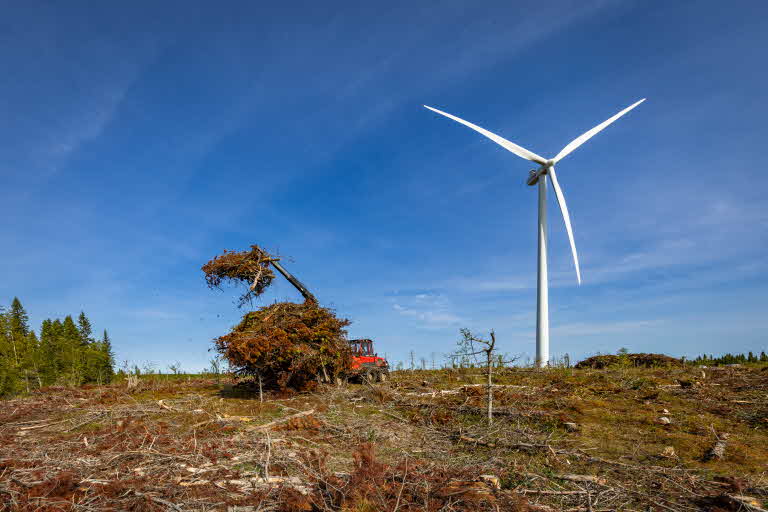
Around 20 percent of Sweden’s wind power is currently produced on SCA’s land, through our own operations and in collaboration with other partners. This corresponds to approximately 11.1 TWh of renewable electricity production. Our land can also be made available for other operations where access to renewable electricity is important, such as data centres and battery storage.
In this way, the same forest landscape can contribute to the energy system in several ways – by providing raw materials for bioenergy and renewable fuels, through wind power, and by providing space for operations with high electricity needs.

Sweden needs several types of energy and several forms of energy production. Our contribution is to make use of the resources we have – forest by-products and wind – and develop them where the conditions are right. This is about both our own production and giving other operators the opportunity to use our land for energy-related activities.
From Swedish raw materials to renewable fuels
Energy supply is not only about electricity. The transport sector also needs renewable alternatives to fossil fuels.
SCA is a co-owner of Gothenburg Biorefinery together with St1, where tall oil from the forest industry is among the raw materials used to produce HVO. SCA and St1 are also planning a larger biorefinery at SCA’s Östrand pulp mill in Timrå for the production of sustainable aviation fuel (SAF).
By processing Swedish forest-based residual streams into fuels, production can contribute to the availability of renewable alternatives in the transport sector as well.
SCA contributes to the energy supply
SCA contributes to Sweden’s energy supply by making use of forest resources in several ways – residual streams as raw materials for bioenergy and renewable fuels, favourable wind conditions as a basis for wind power, and land for operations that need access to renewable electricity. In this way, Sweden’s forests contribute not only to reducing climate impact, but also to strengthening the energy system.
Strength to make a difference
In 2025, SCA delivered a total of 11.2 TWh of bioenergy in the form of forestry residues, bark, chips, pellets, and district and waste heat.
Forestry residues that create a major climate benefit when they replace fossil alternatives so that the use of oil and coal can be phased out.
In many ways, the forest industry is an important part of the backbone of the Swedish economy and climate policy.

Latest news on this topic

Branches and tops by rail - double climate benefit
Since autumn 2024, slash chips have been delivered by train from SCA’s terminal in Töva outside Sundsvall to Eon’s combined heat and power plant in Örebro. When the transport is done by train instead of trucks, carbon dioxide emissions are reduced by 99%, and when slash replaces fossil energy, the climate impact is reduced.

Now the jointly owned biorefinery for biofuel has opened
The jointly owned biorefinery, owned by SCA and St1, is now inaugurated. When fully operational in Gothenburg, the refinery will contribute an annual production of around 200,000 tons of renewable fuel.