
In September, SCA hosted a field excursion for the Collaborative Group for Continuous-Cover Forestry in Southern Norrland. The group visited four sites where SCA has applied different continuous-cover methods.
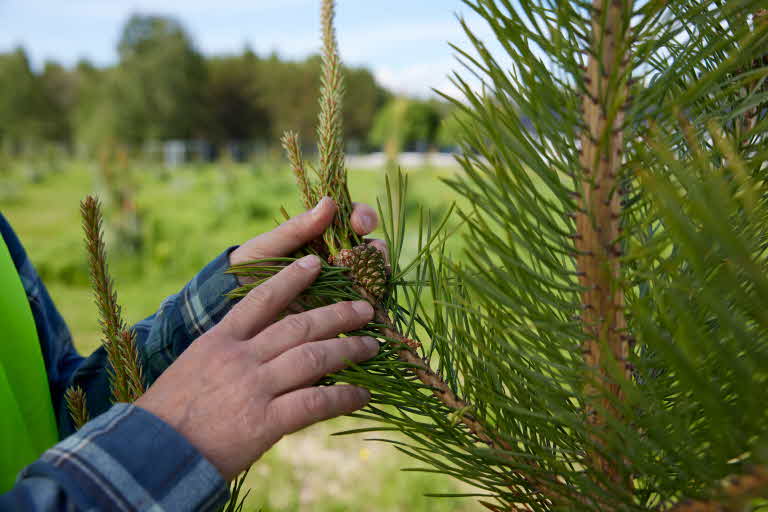
SCA’s pine of the future
- News
- Forest
- Company news
SCA is preparing the next generation of pine seedlings – with up to 30 percent greater carbon sequestration capacity and increased tolerance to warmer weather.
The plan is for the seed orchard to begin supplying seedlings to Swedish forests sometime after 2030.
“This has the potential to significantly increase carbon storage in Swedish forests while also giving us greater confidence in our ability to cope with future climate conditions,” says Ola Kårén, Chief Forester at SCA.
SCA has been working for several years to establish a new pine seed orchard that has now begun producing cones. Through SCA’s nursery operations, Norrplant, trees with desirable traits are selected through natural processes to improve future generations.
As a result, the latest pine seed orchard contains parent trees with the best potential for strong growth and enhanced resistance to warmer conditions.
“When you work with a time horizon of up to 100 years, you want to ensure as far as possible that what we plant today will also thrive several decades from now. That is why we are actively working to develop the best planting material that nature can offer,” says Ola Kårén.
Compared with a mature pine tree currently found in Swedish forests, seeds from SCA’s new seed orchard are expected to increase growth performance by approximately 30 percent. This represents a substantial improvement over previous generations of improved pine seedlings.

SCA's Chief Forester Ola Kårén, showing the new seedlings. Photo: Olle Melkerhed.
“When you work with a time horizon of up to 100 years, you want to ensure as far as possible that what we plant today will also thrive several decades from now. That is why we are actively working to develop the best planting material that nature can offer,” says Ola Kårén.
Compared with a mature pine tree currently found in Swedish forests, seeds from SCA’s new seed orchard are expected to increase growth performance by approximately 30 percent. This represents a substantial improvement over previous generations of improved pine seedlings.
“It is a bit like moving from an old rusty Saab to a modern electric car. Both essentially serve the same purpose, but the new generation performs the same task better and more efficiently. In practice, this means that the climate performance of every site we plant will improve significantly,” says Ola Kårén.
Planting has long been the most effective and reliable way to establish new forests after harvesting. As the performance of planting material improves, the advantage of planting over relying on natural regeneration becomes even greater.
Today’s forests, many of which were established using earlier generations of improved seedlings, absorb more carbon dioxide than Sweden emits. That is positive, but we do not know exactly how resilient these forests will be if temperatures rise further.
“What we are doing now is developing a seedling that ensures every harvest and replanting cycle results in greater carbon storage and stronger resilience for the future,” says Ola Kårén.
Latest news on this topic

SCA and Sami villages met in field excursions
During August, SCA carried out field excursions Älvsbyn and Strömsund with Sami villages that we coordinate our co-planning with. Interest in the meetings was high, and more than 30 reindeer herders from 15 Sami villages took part.

SCA land host for major road project
The EU project Northern Traffic Lights aims to develop digital solutions that can monitor and predict the trafficability and maintenance needs of private gravel roads. SCA is participating as a land host in a project part led by Skogforsk, anh has now two advanced weather stations on its road network along tin northern Sweden.