
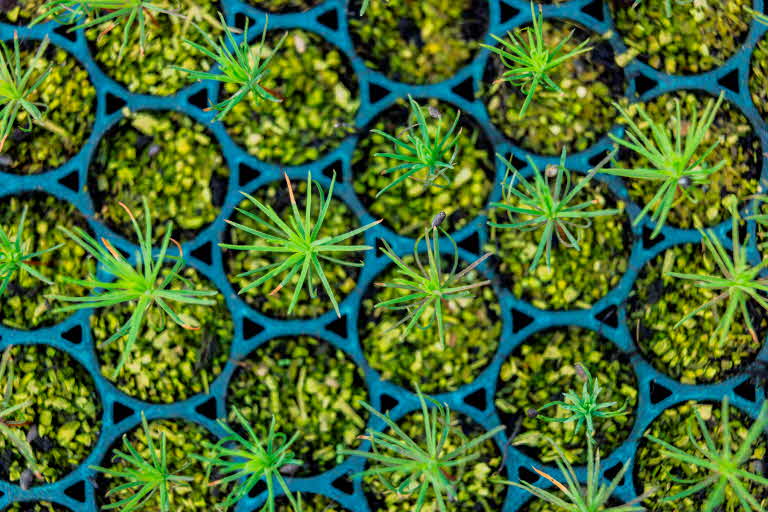
At NorrPlant, our tree seedling operation, we lay the foundation for the next generation forest. Every year, over 100 million seedlings see the light of day on our own tree nurseries. Plants that grow into trees, bind carbon dioxide and form the forests of the future. Every fourth seedling planted i Sweden comes from SCA.
Lightning-fast AI tray assistant at Bogrundet
- News
- Forest
- För skogsägare
SCA’s tree nursery Bogrundet has gained a new “tray assistant” that works at lightning speed. In just one second, the AI model determines whether a seedling tray is damaged and shall be sorted out. “This is a great help and allows us to avoid many unnecessary production stops caused by damaged trays,” says Anders Tolblad, Group Manager at NorrPlant.
Each year, the sowing operators at SCA's plant unit NorrPlant handle approximately two million seedling trays to sow the roughly 100 million seedlings that SCA contributes annually to the forests of the future. Until now, the detection of damaged trays relied on manual inspection, or action was taken only after a production stop had already occurred.
“Identifying and removing damaged trays is an important task. But it has also been somewhat of a work environment challenge, as it is demanding to stand and inspect and manually remove trays all day,” Anders explains.
Bogrundet’s in-house developed AI model is now fully operational, following extensive work by Matthias Larsson, Business Development Specialist within Technology and Digitalisation.
“We saw clear potential in an AI model. It was also particularly timely since the production line was being upgraded ahead of the 2026 sowing season. It has truly been both enjoyable and rewarding,” says Matthias.
Trained on 8,000 images
Matthias invested significant time in defining how the AI model should function before building the interface and testing different camera solutions. He then spent many hours manually training the model to recognise damage such as broken flaps and chipped outer edges, enabling it to identify defective trays accurately.

Two cameras photograph the upside-down tray from two different angles as it
speeds along the conveyor belt. Photo: Matthias Larsson
“Collaboration with the operators has been invaluable, as we needed a shared understanding of what constitutes damage and what tolerance level should apply. Initially, the model reacted to dirt and debris stuck on the trays, but it no longer does. I’ve probably used around 8,000 images to show and train the model to recognise which types of damaged trays should be sorted out,” Matthias explains.
One tray per second
A crucial aspect of the development process was ensuring the model could detect trays at high speed.
“A large number of trays are used, so time efficiency was essential. Our goal was for the model to process one tray per second — and we achieved that,” Matthias emphasises.
The AI model scans all trays at the beginning of the production line. As each tray passes along the conveyor belt, it is photographed using the system’s photo cells and cameras. The AI then determines whether there is damage, such as a broken flap or a chipped edge.

The AI model reacts at lightning speed and detects any damage within one second. This tray has both edge damage and a broken flap. Photo: Matthias Larsson
“When a damaged tray is detected, it is diverted to a separate track and sorted out, while intact trays continue along the production line,” Anders explains.
He is very pleased with the new assistant and commends the work behind it.
“I expected we might encounter a number of initial challenges, but it has gone far better than anticipated. As defective trays are removed, we improve the overall quality of our trays, which is very positive,” Anders concludes.
Top picture: Michael Engman.
Read more about

From seed to plant
We create the forests for the future. Follow the path of the seed, from cone to seedling through plantation, nursery and finally planting in the forest.

Responsible forestry
As a major forest owner, we are responsible for conducting forestry that balances many different values. This means that we combine a high level of renewable raw material production with extensive consideration for biodiversity, reindeer herding, outdoor recreation, and much more. Our conservation commitments often exceeds both legal and certification requirements.
Latest news on this topic

SCA and Sami villages met in field excursions
During August, SCA carried out field excursions Älvsbyn and Strömsund with Sami villages that we coordinate our co-planning with. Interest in the meetings was high, and more than 30 reindeer herders from 15 Sami villages took part.

SCA land host for major road project
The EU project Northern Traffic Lights aims to develop digital solutions that can monitor and predict the trafficability and maintenance needs of private gravel roads. SCA is participating as a land host in a project part led by Skogforsk, anh has now two advanced weather stations on its road network along tin northern Sweden.

SCA has re-wetted 150 hectares of wetland in Västerbotten
Over the past year, SCA has blocked ditches across a 150-hectare wetland area in Lycksele Municipality. In total, around 15 km of century-old ditches have been restored with funding through LONA. “We can already see positive effects of the re-wetting",says Ulf Hallin, Nature Conservation Specialist at SCA.