
The EU project Northern Traffic Lights aims to develop digital solutions that can monitor and predict the trafficability and maintenance needs of private gravel roads. SCA is participating as a land host in a project part led by Skogforsk, anh has now two advanced weather stations on its road network along tin northern Sweden.
Successful basal burning in Ångermanland
- News
- Forest
- Sustainability
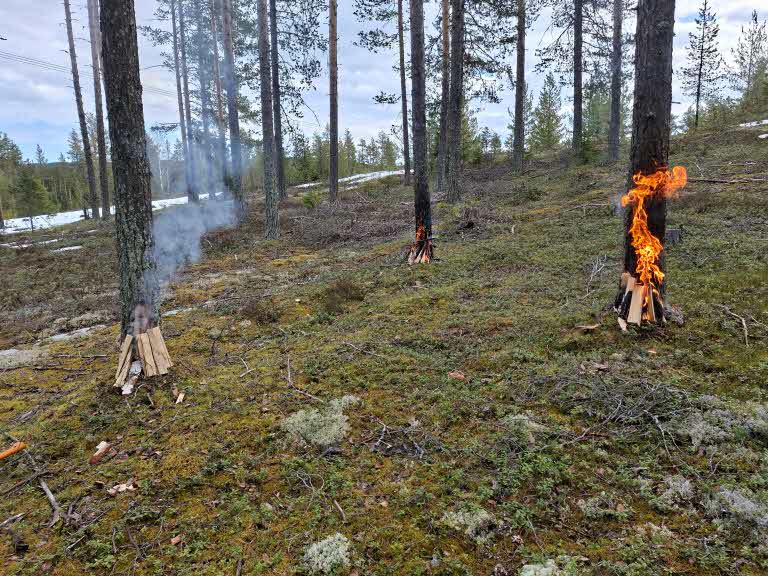
In April, SCA carried out a basal burning on 35 pine trees in Hornsjömon, part of SCA’s Conservation Park Sörgraninge. The fire makes the trees grow more slowly and develop dense wood impregnated with resin. Many species are adapted to this type of wood.

The Hornsjömon area is known for its sandy pine forests, a relatively rare forest type. It hosts many uncommon ground fungi, and in some areas ground lichens are abundant. In addition, the rare plant Lycopodium zeilleri was discovered here in autumn 2024. The current site includes pine trees between 70 and 100 years old.
“We realized that the strong presence of ground lichens means we cannot carry out prescribed burning in this area. Such burning would benefit ground fungi and fire-dependent insects, but in the short term it would negatively affect ground lichens and reindeer husbandry, even though lichens tend to recover and develop better over the long term after fire due to the reduced competition from shrubs and mosses. Instead, we decided to conduct a basal burning on individual pines,” says Askia Sandberg, one of SCA’s nature conservation specialists.
11 sacks of firewood
The burning became something of a joint staff activity, as Askia was assisted by SCA’s two forest management supervisors based in Sollefteå, along with an intern.
“We did not have ready-made portable fires, so we purchased 11 sacks of firewood and built 35 small fires. That was sufficient for the site, which covered less than half a hectare. Each fire burned for about half an hour to an hour,” says Askia.
Thanks to patches of snow still covering parts of the ground, there was no risk of wildfire, and all fires had extinguished within a few hours.
Partial debarking before burning
“We partial debarked most of the pines before lighting the fires. This means we stripped part of the bark from the section of the trunk to be burned. In this way, we help the trees develop a charred wood surface, which benefits species such as the lichen Carbonicola anthracophila and other lichens that thrive on burned wood,” Askia explains, adding:
“Research has shown that an intense and concentrated flame, burning in the same spot for an extended period, produces the desired fire scars effectively.”

Monitoring the development
Basal burning also benefits certain insects that depend on fire-damaged pines for survival.
“We know that the flat bug Stephanopachys linearis is present in other parts of the park where we have carried out prescribed burning. This species lives in the boundary layer between dead and living wood, and we hope that our stem base burning will encourage it to establish here as well.”

However, it will take time before clear effects of the measure become visible.
“Yes, nature is in no hurry. Over time, the pines will shed their bark and begin to grow over the fire scars caused by the burn. Insects and birds, on the other hand, tend to respond quite quickly to fire. It will be exciting to follow the development,” says Askia.
Host for research project
SCA has begun using basal burning as a complement to prescribed burnings for nature conservation. In Ångermanland, SCA is also hosting a research project led by Mid Sweden University to evaluate basal burning as a conservation management method in pine forests and to assess whether it benefits threatened beetle species.
“Researchers from Mid Sweden University conducted burning in the park this winter and are planning additional basal burnings at other locations in Ångermanland,” says Askia. “It is an interesting project that will hopefully contribute to the forestry sector’s efforts to develop effective conservation methods that can be used where prescribed burning is not feasible.”
Latest news on this topic

SCA has re-wetted 150 hectares of wetland in Västerbotten
Over the past year, SCA has blocked ditches across a 150-hectare wetland area in Lycksele Municipality. In total, around 15 km of century-old ditches have been restored with funding through LONA. “We can already see positive effects of the re-wetting",says Ulf Hallin, Nature Conservation Specialist at SCA.

The world’s first electric timber truck has completed its run
The world’s first electric timber truck has completed its time on the road in SCA’s service. After four years and around 130 000 kilometers, the world’s first electric timber truck has now completed its time on the road. During the summer, SCA and Grundbergs Åkeri, which operated the truck, handed it back to Scania. The electric drivetrain has resulted in 220,000 kilograms lower carbon dioxide emissions.