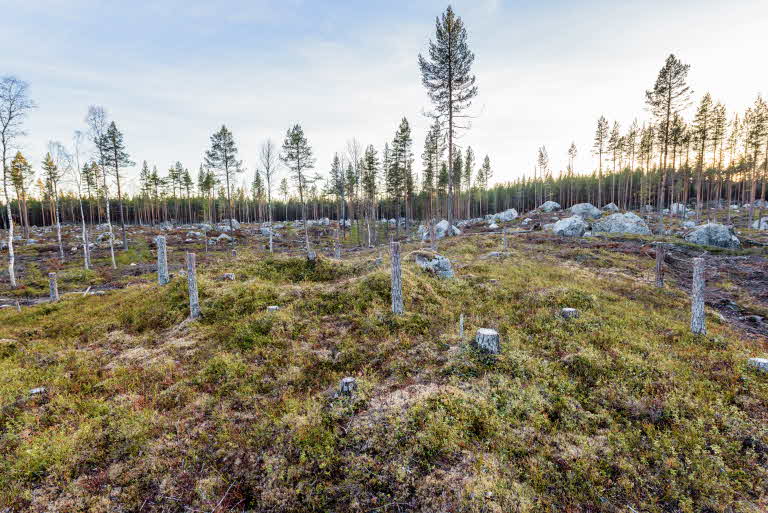
SCA achieves the lowest damage level ever for ancient and cultural remains
- News
- Forest
- Sustainability
SCA is reporting the lowest damage level ever to known archaeological and cultural remains. This goes against the grain of the industry at large as the Swedish Forest Agency announced in December that the damage to ancient and cultural remains has increased, reaching the level of 18 percent in 2025 – the highest since 2020. – SCA noted a total of 1.4 percent damage overall and 0.6 percent damage in connection with soil scarification. This is an excellent result, says Ulla Sandenér, responsible for SCA's silviculture.
For the past ten years, SCA Skog has been dedicated to reducing the number of damages to known ancient and cultural remain in the forest. Over the past four years, the damage level has remained very low, and in 2025, SCA achieved its best result ever.
– When we began working with our "zero vision" in 2015, the damage level for known remains was at 40 percent, but now we are down to just 1.4 percent, according to our annual follow-up. In 2025, we followed up on 469 objects, which is 57 more than the previous year, explains Ulla. The result is due to everyone in our forestry chain working together on this issue.
Soil scarification the greatest risk
During the 2025 survey, SCA recorded a total of seven damaged objects. Three were caused by soil scarification, followed by two from driving damages, and one each from piled debris and storm-felled trees over a site.
– It is still during soil scarification that ancient and cultural remains are at the greatest risk of being damaged. This is because, when a site is exposed to soil scarification equipment, the impact is significant—it cannot be ignored, Ulla explains. But today, we are so much better at protecting these remains, which is very rewarding to see.
Dedicated work
The success is the result of dedicated and focused work by all SCA employees who are involved in activities that affect the outcomes, from site planning and harvesting to subsequent silviculture.
– In the first few years of SCA's "Zero Vision," a lot of the work was about creating new routines and improving communication from planning to execution. Significant efforts were made to improve marking all sites with flags and placing protective stumps (culture stumps) around them, and also adding extra sticks where needed before soil scarification, Ulla says.
Introducing a warning system

In 2022, SCA did something revolutionary, which likely is the most significant contributing factor to the improved protection of ancient and cultural remains within SCA's forests.
– Yes, that year we became the first in the Swedish forestry industry to implement a warning system in all of our soil scarification machines to protect ancient and cultural remains. Thanks to a warning on the map displayed in the machine's computer, the operator is alerted when the machine approaches a site and can avoid driving over it. Today, this warning system is also installed in our harvesting machines, so even the operators of those machines are alerted when they come too close to a protected site. We have different alarm distances for different types of remains, says Ulla, adding:
– The great thing about the warning system is that it works even if the operator does not always have the map showing the sites of the remains in front of them, since the machine's computer switches to the map and flashes when the machine approaches a site.
Persistence pays off
Ulla is convinced that the warning system has made a significant difference in reducing the damage level.
– Absolutely. This year we changed the routine, so we flagged only ancient remains and not cultural ones, yet we still achieved a record result. There is also truth in the saying "persistence pays off" because thanks to everyone's commitment and the entire chain– from planning and production to silviculture – being involved and always focusing on the importance of preserving the remains, it has become part of our daily work. Discussing what we do and what we can do better is crucial. For example, this year, a contractor who, unfortunately, damaged an archaeological site simply called to report it. I am so grateful for that because it also shows dedication, says Ulla, concluding:
– We will continue striving toward our "zero vision," and I am confident that we will achieve it in the future.
Photo: Michael Engman
The Swedish Forest Agency's inventory 2025
The Swedish Forest Agency's latest inventory shows that the proportion of damage to known ancient and cultural remains has increased. The share of sites with damage or severe damage amounted to 18 percent in 2025, the highest level since 2020.
This represents a statistically significant increase compared to 2024, when the corresponding figure was 10 percent. Soil scarification continued to be the single largest cause of damage to ancient and cultural remains. The Swedish Forest Agency's 2025 inventory revealed that the proportion of cultural heritage sites with damage or severe damage due to soil preparation was 10 percent.
Latest news on this topic

SCA and Swedish Sámi National Association agree on long-term collaboration
SCA and Swedish Sámi National Association, the representative organisation for reindeer husbandry and Sámi business and community affairs, have signed an agreement aimed at strengthening cooperation between SCA, SSR and the reindeer husbandry sector. The agreement is intended to develop working methods that improve conditions for reindeer husbandry while ensuring that forestry is conducted in a long-term and responsible manner.

New species found in Västerbotten on SCA land
The very rare beetle Glischrochilus tremulae has found a new home in SCA's Conservation park Tjäderberget, located in the Lycksele area. The species is new to Västerbotten county and has specific habitat requirements, primarily living in sun-exposed hollow aspens.

Record timber volume on railway in 2025
In 2025, SCA Skog achieved a milestone by transporting a total of 3.1 million cubic meters of roundwood by rail. This marks the highest timber volume in SCA's railway system to date. Transporting timber by rail is beneficial for both the environment and profitability.