New species found in Västerbotten on SCA land
- News
- Forest
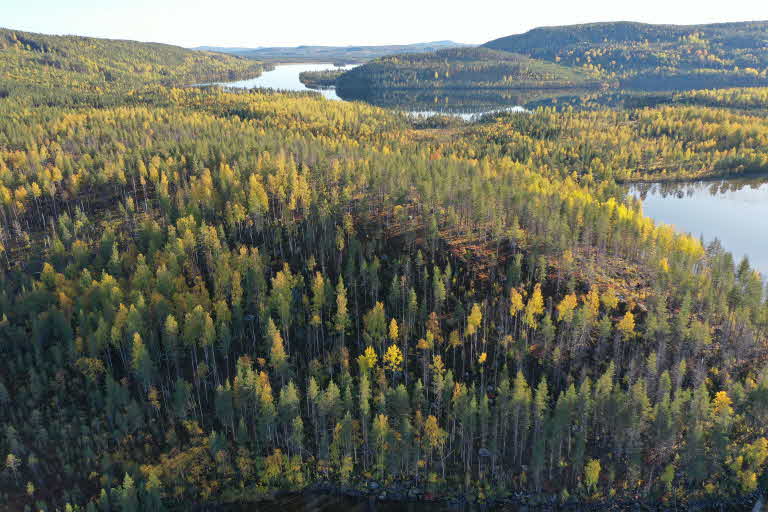
The very rare beetle Glischrochilus tremulae has found a new home in SCA's Conservation park Tjäderberget, located in the Lycksele area. The species is new to Västerbotten county and has specific habitat requirements, primarily living in sun-exposed hollow aspens.

Male species of Glischrochilus tremulae.In reality it is around 5 mm big.Photo: Roger Mugerwa Pettersson.
"This was a real wow-moment since this is a beetle that we hardly knew existed," says Roger Mugerwa Pettersson, a beetle specialist who discovered the beetle in Tjäderberget.
Roger has conducted several species inventories for SCA in Tjäderberget's Conservation park. The discovery of Glischrochilus tremulae consisted of five individuals, found in traps that Roger had set on a couple of large hollow aspens, so-called "hollow aspens," in an aspen-rich area of Tjäderberget.
"It's always exciting when we find rare species on our land," says Ulf Hallin, SCA's nature specialist and park manager.
Discovered in 2015
The beetles were actually captured back in 2015. Since then, the five beetles have been part of Roger's extensive insect collection, assumed to belong to a much more common species of the same beetle family.
"This rare species is easy to confuse with another, more common beetle called Glischrochilus quadripunctatus, or the four-spotted sap beetle. However, Glischrochilus tremulae is slightly smaller and has a more convex pronotum compared to the more common beetle. The more common beetle is classified as 'Least Concern' on the red list and is primarily associated with coniferous trees, although it also prefers deciduous trees," Roger explains.
Correct species identification
The discovery in Tjäderberget may never have been recognized if another insect researcher hadn't stumbled upon the species. While identifying collected beetle specimens, the researcher reached out to Roger for clarification.
"I went through my beetle collection and realized they were likely the rare species. I’ve also had my identification confirmed by Finnish researcher Tom Clayhills, one of the three scientists who first described the specie in 2016," Roger explains.
Found in areas rich in deciduous trees

Very little is known about Glischrochilus tremulae. The findings in Tjäderberget are the oldest known in Sweden. Apart from this, there are just a few other registered discoveries in recent years, one from Vindeln in 2022. The common factor among Swedish findings is that the species is only encountered in areas known for their rich deciduous trees values.
"Glischrochilus tremulae is very particular about its habitat, thriving in forests dominated by aspen. It lives in old, hollow aspens, which have become hollow due to rot. These trees represent a relatively rare but crucial habitat for many insects and birds," Roger explains, adding:
"The species is also a bit tricky—or perhaps clever—since it often coexists with its much more common relative, allowing it to stay under the radar."
Glischrochilus tremulae is so unknown in Sweden that it has not been assessed in the Swedish Red List. However, in Finland, there are records of the beetle dating back to the 1980s.
"Finnish specialists believe the species has existed in Finland for a long time, and I suspect it has likely been in Sweden for a long time as well. I think that if we were to study older Swedish insect collections closely, we might find old specimens from the 19th or early 20th century."
Actions to benefit the species
To help the beetle continue thriving in Tjäderberget's biodiversity park, Ulf Hallin hopes to implement some measures.
"We might take steps with aspens in the surrounding area to recreate hollow aspens in sun-exposed locations. Perhaps we could try veteranization of some aspens to encourage heart rot. This could involve, for example, inoculating them with aspen bracket fungus or drilling holes with a power drill as we’ve done with other tree species in the park, which increases the likelihood of the tree beginning to decay. We'll see what might work," says Ulf.
Roger, who is part of the Swedish Species Information Centre’s expert committee for beetles, hopes it will be possible to determine how long the species has been present in Sweden.
"One way would be to study insect collections at institutions like the Swedish Museum of Natural History in Stockholm to see if the species is found there. However, this would require funding, so we’ll see how it goes," Roger concludes.
More about Glischrochilus tremulae
Findings of the species in Sweden are very few and, so far, have been made in Södermanland, Uppland, Dalarna, Västerbotten, and Norrbotten.
The species was first described in 2016 by three researchers in Finland (Clayhills, Audisio & Cline, 2016).
Top picture: David Rönnblom
Latest news on this topic

Record timber volume on railway in 2025
In 2025, SCA Skog achieved a milestone by transporting a total of 3.1 million cubic meters of roundwood by rail. This marks the highest timber volume in SCA's railway system to date. Transporting timber by rail is beneficial for both the environment and profitability.

Almost 31,000 hectares of new key habitats reported
Over the past five years, SCA has added 30,763 hectares of new key habitat within the framework of the company’s forestry operations. In total, this means that roughly 78,000 hectares of the company’s land are assessed as key habitat.

1,100 hectares of wetland restoration on SCA land
Since 2021, SCA has been dedicated to restoring selected wetlands on its land. This includes both restoration projects managed directly by SCA and those conducted in partnership with others, where SCA acts as the landowner. Thanks to these efforts, we have now surpassed over 1,100 hectares of wetland restoration.