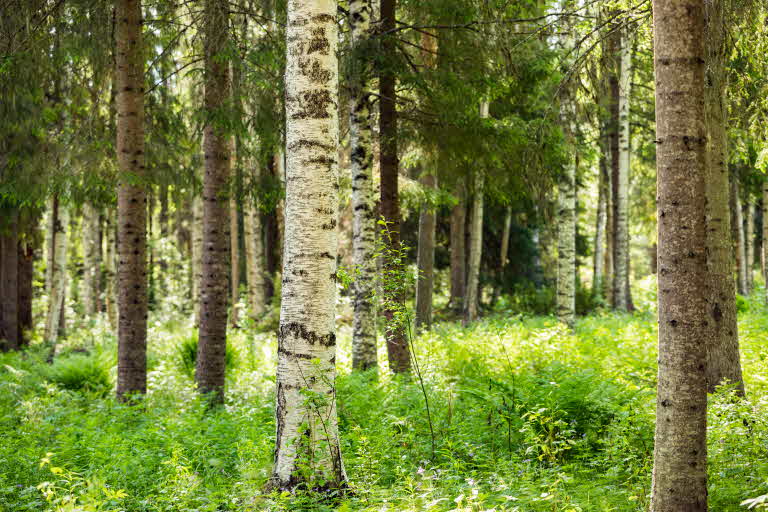
Almost 31,000 hectares of new key habitats reported
- News
- Forest
- Company news
Over the past five years, SCA has added 30,763 hectares of new key habitat within the framework of the company’s forestry operations. In total, this means that roughly 78,000 hectares of the company’s land are assessed as key habitat.
“For us, it is a good sign that our continuous nature conservation work is functioning, delivering results, and over time leading to increasingly large areas with important and very high conservation values,” says Ola Kårén, Head of Forest Management at SCA Skog.
In the early 1990s, Sweden and SCA began identifying key habitats, and the concept has evolved over time. A key habitat is an area in the forest that, due to its high conservation values, is of great significance for forest plants and animals. The Swedish Forest Agency was responsible for identifying key habitats on private landowners’ properties, while forestry companies carried out their own inventories. Logging within key habitats may only be conducted to promote conservation values according to the FSC and PEFC certification standards. SCA’s forestry operations were certified in 1999, and like other forestry companies, SCA conducted extensive inventories and established methods to identify key habitats. Sweden’s expert authority, the Swedish Forest Agency, decided at the turn of 2021–2022 to cease its own registration of key habitats.
However, SCA has chosen to continue working with the concept and has registered nearly 31,000 hectares of new key habitat during the period 2021–2025. The stands have been identified as part of a broader program of conservation value inventories conducted by SCA during this period, as well as during harvest planning.
“Identifying high conservation values is still an important part of FSC certification. To be as effective as possible, we must protect stands with the highest conservation values, while areas with lower values are managed with general environmental considerations. Through stand-level inventories, we also gain a good understanding of how conservation values are distributed across the landscape and where we can concentrate conservation efforts,” says Ola Kårén.

Ola Kårén in the forest.
During this period, SCA has also downgraded a smaller area from the key habitat designation. This is due to the fact that the early reporting was sometimes imprecise. Older forest classifications were used, and entire stands were often registered. As a result, areas that are not key habitats were included in the reporting and later adjusted for greater accuracy.
In total, this involves roughly 1,200 hectares over the past five years that have been reclassified into another conservation value category.
“Overall, new reporting is about 25 times larger than the older, imprecise reporting now being refined. It is of course valuable that the total area is increasing, but it is also important to be as accurate as possible so as not to dilute the meaning of the concept,” says Ola Kårén.
According to the FSC standard for forestry in Sweden, it is the certified forest owner who is responsible for identifying key habitats and preserving biological diversity within them by excluding these areas from forestry or performing conservation-oriented management.
The latter means that areas containing key habitats may over time become subject to forestry measures.
“We usually refer to this as alternative harvesting methods, which in practice means clearcut-free methods aimed at protecting or sometimes enhancing the key habitat. It often involves promoting light-demanding tree species such as pine and deciduous trees by removing spruce, thereby reducing the risk of spruce encroaching on the conservation value that is meant to be preserved. In other cases, it involves creating conditions for controlled burns, which are valuable for certain fire-dependent species,” says Ola Kårén.
Photo: Michael Engman and Olle Melkerhed.
Latest news on this topic

New RoRo traffic in the port of Piteå reduces emissions
Starting on 1 October 2026, SCA will implement changes to its sea transport using RoRo vessels (Roll-on/Roll-off) by reducing speed, increasing vessel load factors, and adjusting how the ports in Umeå and Piteå are used. One effect of these changes is that emissions from the vessels will be reduced by approximately 40 percent.

1,100 hectares of wetland restoration on SCA land
Since 2021, SCA has been dedicated to restoring selected wetlands on its land. This includes both restoration projects managed directly by SCA and those conducted in partnership with others, where SCA acts as the landowner. Thanks to these efforts, we have now surpassed over 1,100 hectares of wetland restoration.

SCA’s defibrillators can save lives in local communities
By making defibrillators at SCA’s local offices in northern Sweden accessible to the public 24/7, more lives can potentially be saved. This is the hope of SCA Skog’s health and safety network, which has selected several local offices as pilot sites.