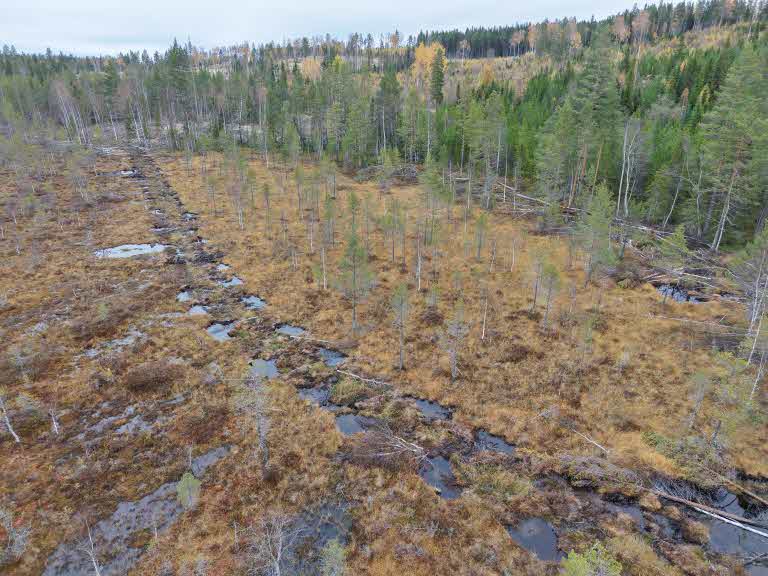
Over 1,100 hectares of wetland restoration on SCA land
- News
- Forest
- Sustainability
Since 2021, SCA has been dedicated to restoring selected wetlands on its land. This includes both restoration projects managed directly by SCA and those conducted in partnership with others, where SCA acts as the landowner. Thanks to these efforts, we have now surpassed over 1,100 hectares of wetland restoration.

Between 2021 and 2025, a total of 1,165 hectares of wetlands have been restored on SCA land.
"SCA has independently managed 883 hectares, while other stakeholders have been involved in 282 hectares! And if I also include the two extensive peat bog restoration projects covering 325 hectares which we also restored during this period, bringing the total figure even higher," says Anna Cabrajic, forest ecologist at SCA and the person who compiled the figures, and continues:
"This is a fantastic achievement, led by our nature conservation specialists across SCA's geographic areas,".
Enhance our efforts
Wetlands, such as mires and rich fens, serve as nature’s own purification filter and play a critical role in the ecosystem.
"In 2021, we set an ambition to enhance our efforts to restore and rewet wetlands in order to support biodiversity, reduce greenhouse gas emissions, and improve the wetlands' ability to retain water in the landscape," Anna explains.
Common measures for wetland restoration include filling in ditches, constructing dams with ditch plugsto raise the water level, and removing some trees.
"By restoring wetlands and filling in ditches, we help to reestablish the natural hydrology of the mire. This means the mire becomes wetter, allowing water to remain in the wetland for a longer period where it is naturally purified. A wetland captures and binds nutrients and heavy metals from the surrounding land, which improves the water quality in streams and helps stabilize water flows," Anna explains.
Contribute to climate goals
SCA has also removed some trees during the restoration work, in cases where it was necessary to enable ditches to be filled in. On mires, there are often a significant number of smaller trees growing along the ditches.
Restored wetlands also represent a valuable habitat for many animals, such as wading birds, amphibians, and insects, as well as plants that thrive in or near water.
"All wetland restorations are considered to contribute positively to Sweden's climate goals for Thriving Wetlands, Living Lakes and Watercourses, and Reduced Climate Impact. I believe this highlights how significantly we contribute," says Anna.

18 kilometers of ditches
Since 2021, SCA has carried out approximately three wetland projects per year. One of these was the restoration of the Ejdån-Malmvattenån mires in Sollefteå Municipality, completed in 2025.
"SCA’s efforts covered six drained mire areas around Lake Graningesjön, where we restored approximately 18 kilometers of ditches and rewetted about 150 hectares of mire. We began clearing some forest in May 2025 and then continued to fill in the ditches during the summer, completing the work by the end of September," explains Mikael Berg, who works with wetlands at SCA.
Follow the development
This project, like most of SCA’s wetland restoration efforts, received funding from LONA. The Local Nature Conservation Program (LONA) promotes long-term commitments to conservation initiatives.
"It will be exciting to follow the development of the mires in the coming years. In other projects, we’ve seen results fairly quickly, so we’re hopeful for the same here. These types of environments often attract a lot of bird species," says Mikael.
Restored peat extractions
SCA has also been involved in the restoration of a few peat extraction sites on SCA land in recent years. The sites were in use until the early 2020s and were part of Öviks Energi’s operations.
"The aftercare of the Mörttjärnsmyran and Norrmossaflon peatlands was carried out by Neova, which managed the extraction. During the consultations we conducted in 2023, SCA had a clear vision of how the restoration should be carried out, and that is exactly how it was done. It’s a thoroughly completed effort where all drainage, including edge ditches and furrow ditches, has been filled in.
The Mörttjärnsmyran peatland is part of Mörttjärnsmyren, where we also restored 5,000 meters of ditches this year as part of the Ejdån-Malmvattenån project, creating a cohesive area," says Mikael, adding:
"Norrmossaflon will evolve into a fantastic wetland area adjacent to an 80-hectare burned forest area created after a wildfire in 2018. This is highly promising for biodiversity in the region."
Photo: Mikael Berg.
Latest news on this topic

New species found in Västerbotten on SCA land
The very rare beetle Glischrochilus tremulae has found a new home in SCA's Conservation park Tjäderberget, located in the Lycksele area. The species is new to Västerbotten county and has specific habitat requirements, primarily living in sun-exposed hollow aspens.

Record timber volume on railway in 2025
In 2025, SCA Skog achieved a milestone by transporting a total of 3.1 million cubic meters of roundwood by rail. This marks the highest timber volume in SCA's railway system to date. Transporting timber by rail is beneficial for both the environment and profitability.

Almost 31,000 hectares of new key habitats reported
Over the past five years, SCA has added 30,763 hectares of new key habitat within the framework of the company’s forestry operations. In total, this means that roughly 78,000 hectares of the company’s land are assessed as key habitat.